Version 4 - The Glow Up
Share:

Around this time last year, we launched Game Oracle, a market research platform with the goal to help broaden our understanding of the gaming market, alleviate anxiety around which game idea we should commit to (let's be honest, we have too many of those), and set realistic goals. It was a selfish endeavour if I'm honest — we were just building the product we desperately wanted.
Twelve months later and Game Oracle is all grown up. It started with one simple tool, Data Explorer, which lets you explore the entire Steam ecosystem using natural language, powered by our map of every game on Steam. That soon grew into two dedicated tools for market insights: Saturation Map, which lets you visualise market saturation across the whole of Steam, and Game Gap, which offers predefined market segments to help identify underserved audiences and missed opportunities. Our final addition was Concept Compass, intended to be the crème de la crème of idea validation — you provide the game concept, we provide the list of competitors, projections, targets, and resources to get started.
Throughout this journey though, Jennie and I have been laser-focused on the practical. How do we make the map as accurate as possible? What functionality should we provide? What tools do our customers need? This has been fun and we've learned a lot, but my god, what we built was not exactly...pretty. It was functional, but we had let looks and usability fall by the wayside.
So late last year, Jennie and I made a commitment that in the new year we would ship v4.0 and give the platform a much-needed glow up.
A Complete New Look
We've been using Skeleton UI for a while but have continuously been using version 2 of the framework. We migrated to Svelte 5 early last year, but with so much up in the air, we never made the commitment to move to Tailwind 4 or the latest Skeleton UI release. Since that time, however, the components library has become increasingly more stable, so it seemed a better time than ever to finally make the leap.
After what felt like a lifetime of researching and toying with designs (it was probably just two weeks, but it felt LONG), we settled on a new glassmorphism look — it feels futuristic, clean, chic, everything the platform has been lacking to be honest.
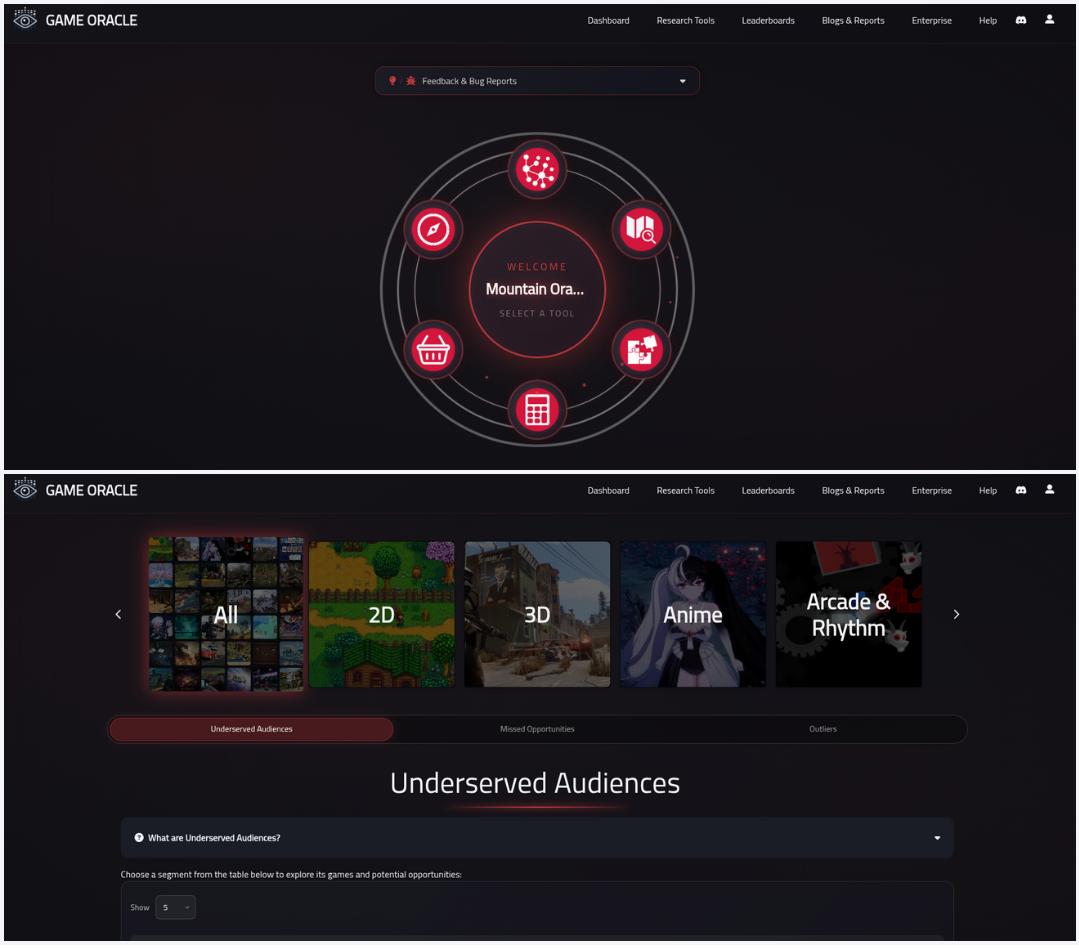
Now, if I'm completely honest, I cannot take all the credit. A huge amount of the legwork here is handled by Tailwind and the amazing Skeleton component library. On top of that, I used Claude Opus extensively to generate, troubleshoot, and learn how to create this UI.
I'm not afraid to admit that I am not a web designer. I am first and foremost a Data Scientist and Engineer. I get the backend stuff; I can build models, handle database logic, and I'm even comfortable managing complex state in TypeScript. But CSS... man, I just don't get it. I know how important it is to make things pretty and user-friendly, but it has never been my forte.
If we're realistic with ourselves, we just cannot be experts in everything. Eventually, something has to give and you need some hand-holding. This is where copilots and AI have been outstanding for me. Typically, my workflow goes something like this:
-
I isolate a single component, say a navigation bar, and I ask Claude (I like to use GitHub Copilot) to generate a first draft.
-
I then use Perplexity to review the code and explain it to me — I am a big fan of Perplexity's research and grounding capabilities.
-
From there I make necessary changes myself making sure to ask Perplexitiy anything I am unsure about
By exercising this pattern and resisting the urge to just iterate in an "agentic vibe loop," I reduce friction while also managing to learn what is necessary to comprehend my codebase. This practice has allowed me to grasp key concepts over the past year like rulesets, properties, media queries, etc.
The overall result is a user interface that I am finally proud of.
Game Gap Reborn
The other big addition to v4.0 is a massive improvement to how we identify market segments of interest in Game Gap. I decided to stop messing around with basic heuristics and go back to my roots, diving deep into the kind of community detection algorithms I used during my PhD. Back then, I was utilising these methods to analyse single-cell data from sepsis patients, trying to find signal within biological noise. Now, I’m applying that same rigorous mathematical framework to the chaotic ecosystem of Steam. It turns out that isolating distinct cell populations isn’t all that different from isolating distinct gaming markets — the math holds up beautifully.
This return to hard data science has allowed us to isolate significantly more meaningful clusters of games from our Steam Map. Rather than relying on broad tags, we can now mathematically pinpoint specific sub-niches and "islands" of gameplay that traditional categorisation misses. This precision helps us identify the true missed opportunities, the underserved audiences, and gaps in the market where player demand is high, but quality supply is surprisingly low.
We aren't just keeping these insights locked in the dashboard, though. We want to show you exactly what this data looks like in practice. Over the next year, we will be exploring some of the most fascinating markets these new algorithms have unearthed in a series of videos on our YouTube channel. If you want to see deep dives into these hidden opportunities, come join us at https://www.youtube.com/@Game-Oracle.
Bonus: Concept Compass Upgrades
This update was completely unplanned but is a great addition to this latest release. Inspired by some great community feedback (shout out to Matt from Duck Reaction), we realised the previous algorithm for Concept Compass just wasn't hitting the mark. The goal has always been to be the ultimate idea validation tool — helping you commit to a project with realistic expectations — but the competitor matching was previously too hit-or-miss. We’ve completely overhauled it, and now you’ll see a broader list of competitors, a specific relevancy score, and a helpful summary explaining exactly why a competitor is similar to your concept.
Under the hood, we’re now using a sophisticated three-step process: we pull candidates from our Steam Map, rank them with a fine-tuned model, and finally use an LLM to cross-check relevance and generate the summaries. It’s an attempt to apply precise science to an art form, so while it might not be perfect (subjectivity is always tricky), it’s a massive step forward. We’re committed to iterating on this, so please keep the feedback coming — it’s what helps us build better tools for everyone.
Wrapping Up
Version 4.0 represents a pivotal moment for us. It bridges the gap between the raw, complex data science that powers our backend and the accessible, user-friendly experience you actually deserve. It’s been a year of growing pains, deep dives into algorithms, and wrestling with CSS, but we believe we’ve finally built a home for market analysis that feels as professional as the insights it provides.
We built the original tool because we needed it, but we built this version because of how much you’ve all used it. We’re incredibly excited to get this update into your hands and see what you uncover in the data. Please jump in, explore the new features, and as always, let us know what you think. We’re just getting started.