AI in Games: How Many Games Are Using AI?
Share:

The Elephant in the Room
The topic of Artificial Intelligence (AI), or more specifically generative AI, in game development is a very controversial topic. There are passionate arguments from both sides of the aisle, reasoning for and against its use with various degrees of nuance in terms of how and where AI should be applied in the creative process. In this two-part series we are not going to weigh in on any of these arguments, quite frankly there are plenty of others more qualified than ourselves that are leading the ethical debate. Instead, we're going to seek to answer two questions from neutral ground and let the data speak for itself:
- How prevalent is the use of generative AI in games published on Steam in 2025?
- What is the impact of AI disclosure on Steam sales?
In this blog we will be focusing on the first question.
AI Disclosure
In January 2024, Valve introduced mandatory AI disclosure requirements for games on Steam, requiring developers to declare whether they use AI-generated content in two categories: pre-generated content created during development (such as art, code, or audio) and live-generated content produced while the game is running1. The policy was implemented after Valve took time to assess the risks and legal landscape surrounding AI technology, and requires disclosures to be displayed on store pages so players can make informed purchasing decisions, with additional safeguards and reporting systems for live-generated content1.
Despite the disclosure statement being mandatory, there is the chance that some developers might not disclose AI use. It is advisable that people are honest with Steam, they control the marketplace and whether a developer gets paid or not! However, with the heated ethical debate around AI, it's reasonable to assume that some developers might not be completely honest with the extent of AI use because they fear backlash. Although there are a few examples of games that were released before the AI disclosure statement was mandatory and the developers have chosen to edit their store pages and introduce AI disclosures, this is something Steam does not enforce for games released before the policy change.
We recognise that there are limitations with the data, but we still felt a lot could be gained from studying the AI statements. So please proceed with the understanding that this analysis, like any, is not perfect.
Before we continue it is also worth briefly discussing the blurry definition of AI. The term "AI" encompasses a broad spectrum of technologies, from rule-based decision trees and recommendation algorithms to pattern recognition systems and complex reasoning models. Traditional AI excels at analysing data and making predictions within defined parameters, while generative AI creates entirely new content such as text, images, and audio. In our analysis, we assume the focus is on generative AI tools like large language models (LLMs) and image generators, as developers are unlikely to disclose conventional AI techniques such as pathfinding algorithms, enemy behaviour systems, or procedural generation that have been standard in game development for decades.
The Number of Games Declaring AI Use Shot Up Rapidly
So with those limitations and assumptions laid out, lets get into the meat of it. We collected data on every game released on Steam, extracted their AI disclosure statements, and analysed their content. In total we identified 16,554 games released between January 2025 and November 2025. Of those, 20.9% had an AI disclosure statement. As of November 2025 there are also 33,446 games marked as coming soon with 9.1% having AI disclosure statements; we suspect some disclosure statements will be added on for release. For the purpose of this analysis we focused solely on released titles.
In the chart below we plot the number of releases since late 2022. It's fairly safe to assume that generative AI has only been used in mainstream game development since the release of ChatGPT back in Dec 2022. We see that since the start of 2024 the number of monthly releases on Steam has rapidly increased. At the same time the number of games disclosing AI use has also increased.
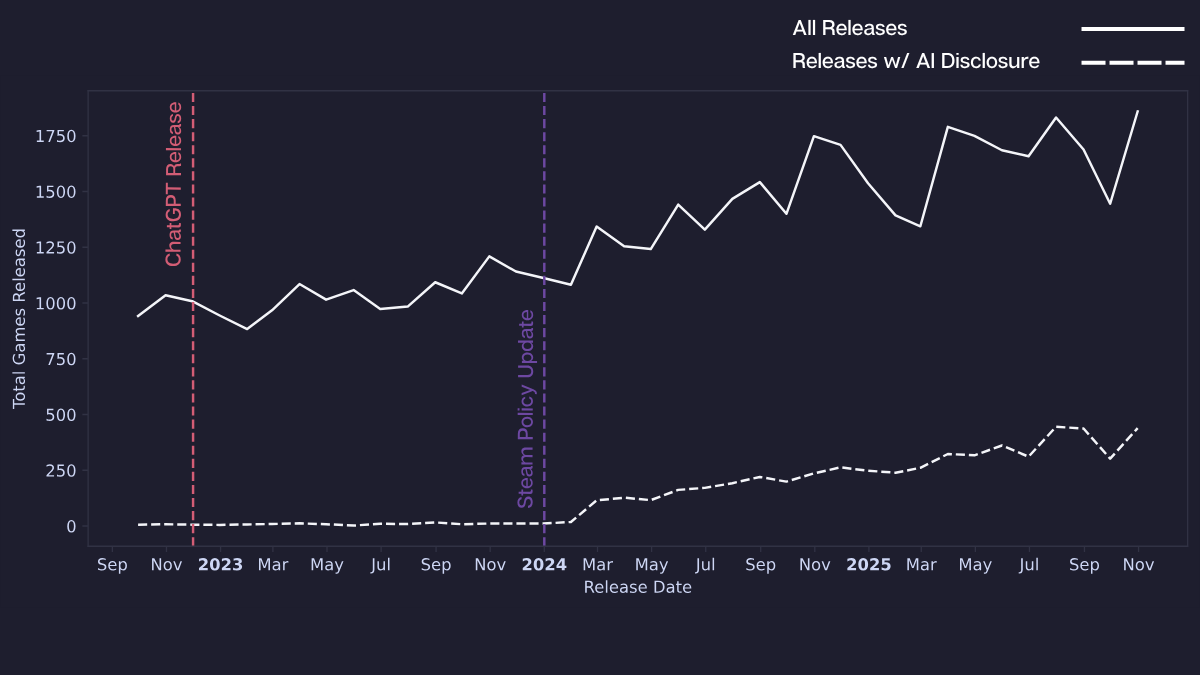
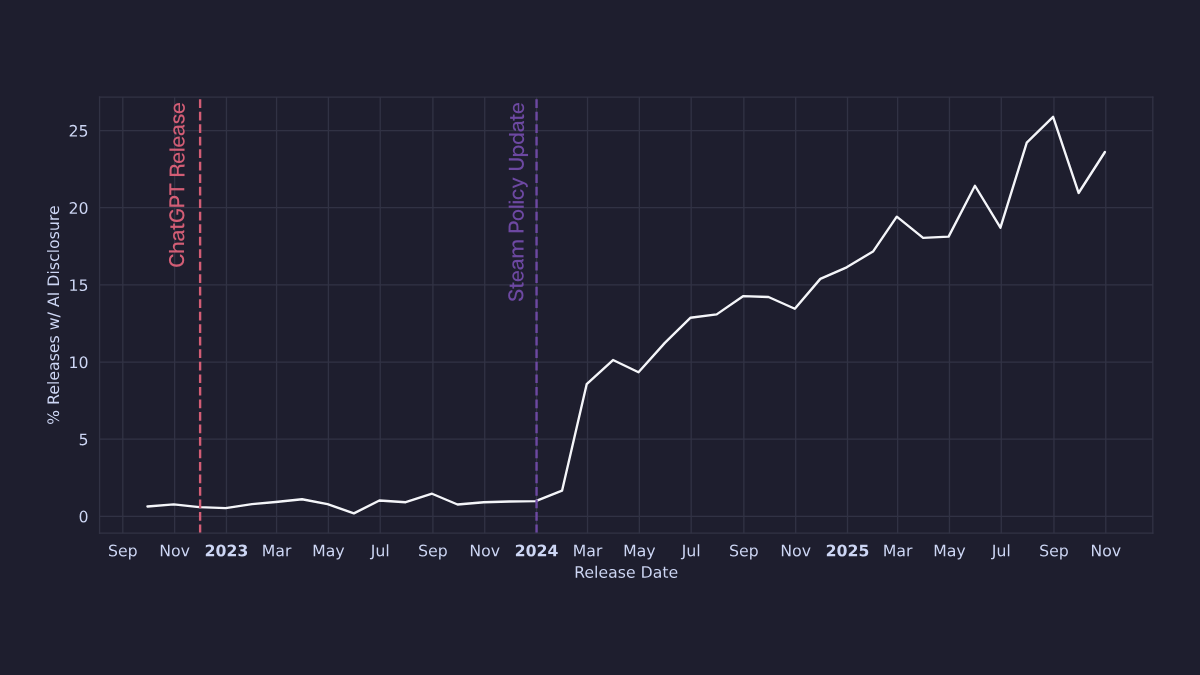
The growth of AI use in the chart above looks subtle, but when we look at a chart of the percentage of released titles disclosing AI use, it paints a stark picture. The percentage of games disclosing AI has shot up rapidly, with as many as 25% of releases in September 2025 declaring the use of AI.
How Are Developers Using AI?
So if AI use is obviously prevalent how are developers using this technology? To answer that question we had to take a closer look at each statement. Some statements were incredibly short, with a single word like "Voice", "Art", or "Music" and others were essays, but on average most statements consisted of a sentence or two. This meant we could apply a technique called Named Entity Recognition (NER). Ironically AI is incredibly helpful for this type of analysis. Specifically, we used a fine-tuned DeBERTa model to classify statements into seven categories of AI use:
- Visual art and graphics: the use of AI to create images, character art, icons, backgrounds, and any other visual elements within the game
- Code and development: co-pilot and LLM tools used specifically to generate and test code
- Character behaviour: live-generated content that modifies character behaviour in-game such as chat-bots and responsive agentic AI systems
- Marketing materials: the use of AI to generate marketing materials include capsule art and trailers
- Audio and music: using AI for voice acting, sound effects, and music
- Translation: using AI to translate voices and text into multiple languages
- Story and dialogue: using AI to generate scripts, dialogue, and game narrative
We treated this as a multi-label classification task, in other words an AI statement can elude to the use of AI in multiple ways e.g. a game developer might use AI to generate in-game images, marketing images, and audio, in which case they would be classified as belonging to three of the above seven categories.
There were about 6% of AI disclosure statements that we could not classify, either due to a lack of relevant information or incomprehensible text. However, we found our NER model gave us about 89% accuracy across individual categories for the remaining statements, so we're confident with the analysis.
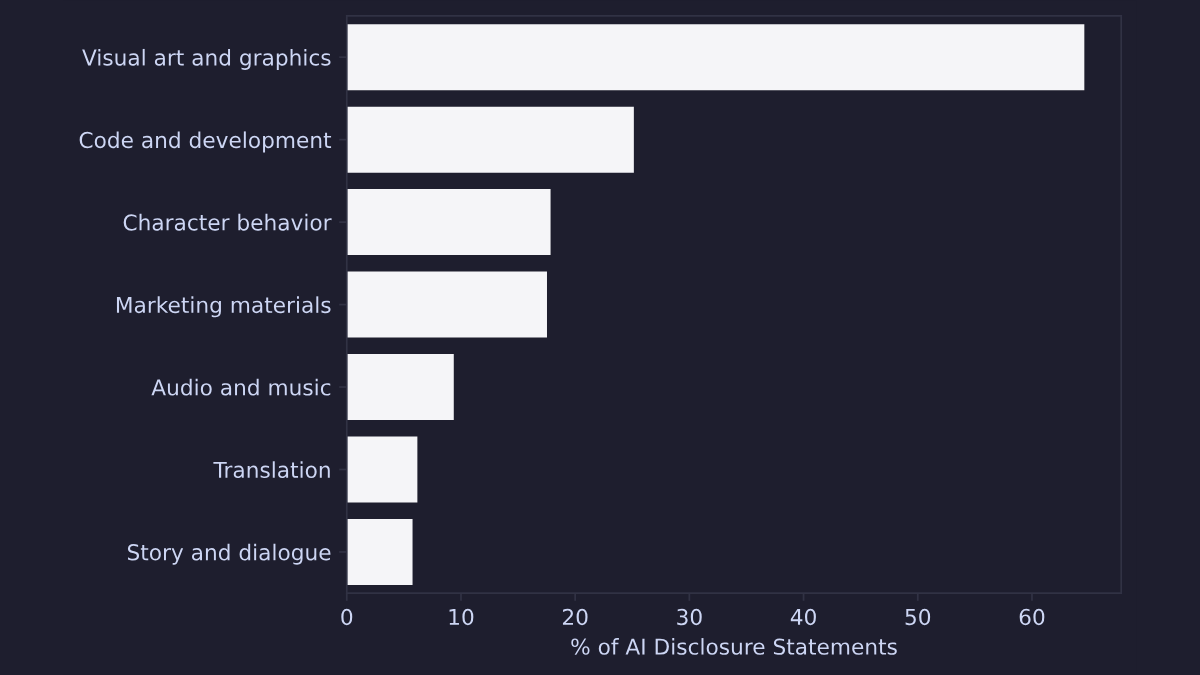
In the bar chart below we show the percentage of AI statements that were classified into the above categories. The most common use case is visual art and graphics. That should come as no surprise given that art is the most time consuming step in game development and visual transformers and diffusion models have become very popular. We were surprised, however, by the lack of games applying AI for translation purposes. Research shows that game localization significantly impacts commercial success, with 76% of gamers preferring to purchase games in their native language and 40% refusing to buy non-localized games entirely2,3. It seems as if generative AI would be an ideal use case for localisation and yet there appears to be a lack of adoption in this regard, with developers instead focusing on its application to art and code.
What Kind Of Games Are Using AI?
If we know how people are using AI the next question is where are they using? Or more specifically, what types of games see the most prevalent AI use? To answer this question we turn to our Saturation Map which provides us with a heatmap of the entire Steam marketplace which allows us to quickly visualise how densely populated areas of the market are. The Saturation Map is shown in the image below (left). Blue regions contain fewer games whereas red regions are more densely populated with more games on the market.
On the right hand side of this image we have the same map, but we've only included games with an AI disclosure. To make things a little clearer, on the complete Saturation Map (left) we have labelled some of the more prominent regions with the type of games you could expect to find in that area of the market.
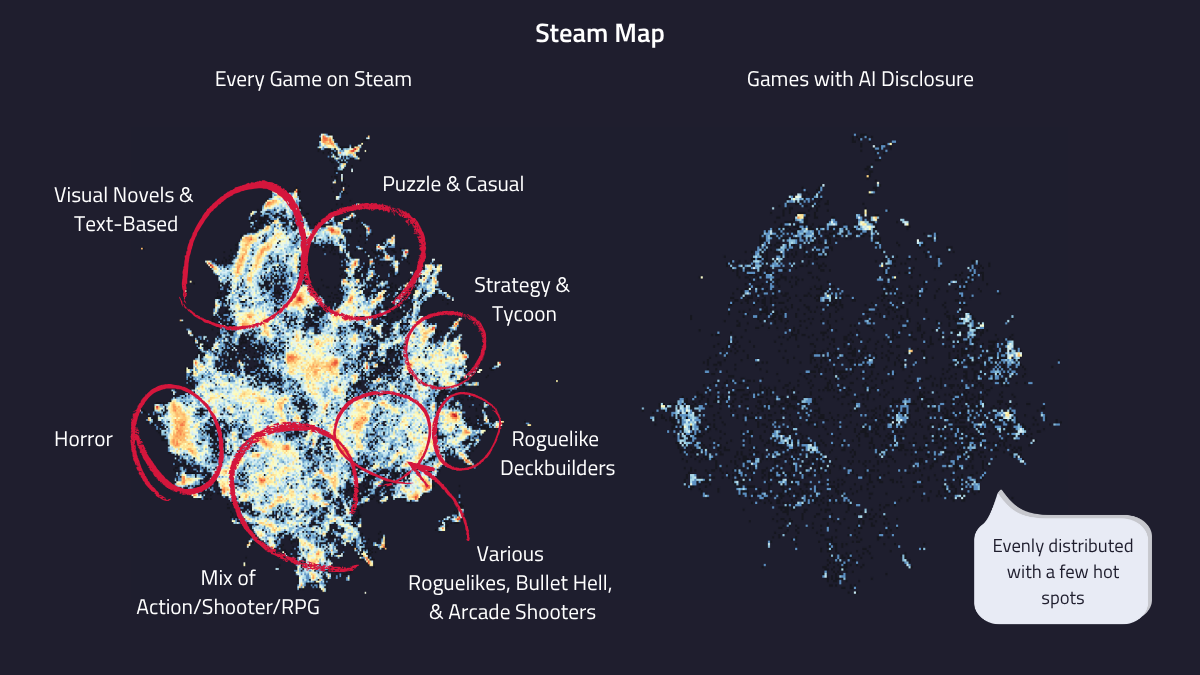
What is immediately obvious from the image above is how AI disclosure is pretty evenly distributed across types of games, which might come as a surprise since we could assume AI would be more applicable to some genres than others. There are a few hot spots however and if we break it down by art style we can see that text-based games, like visual novels, have the most prevalent AI use amongst all titles released in 2025 (to date):
| Art Style (Total Games) | % of 2025 Releases with AI Disclosure |
| 2D (8316) | 21.8% |
| 3D (8015) | 20.0% |
| 2.5D (824) | 18.9% |
| Text-Based (800) | 24.8% |
Looking at some of the common user-defined tags used to specify genre (things like "Strategy", "RPG", "First-Person", "Action & Adventure") there really is no dominant tag amongst games with AI disclosure statements. Around 10 - 20% of these games are tagged with "Sexual Content", "Nudity", "Visual Novel", and "Anime" which suggests a slightly more predominant use of generative AI in adult themed visual novels — these games reside in those bright regions at the top of the AI disclosure Saturation Map (right) in the image above.
Despite this observation, the prevalence of AI disclosure in these games is not enough to declare them significantly different to other games released in 2025, but it does suggest a growing trend. Overall, AI use doesn't appear to be exclusively concentrated in one particular genre and is rather becoming normalised across the entire Steam market.
Prevalent and Growing
The data reveals an unmistakable trend: AI disclosure in Steam games is not just present, it's accelerating rapidly. With 20.9% of games released in 2025 declaring AI use, up from barely 1,000 titles just over a year ago, the integration of generative AI into game development has become normalised across the platform. Visual art and code generation dominate the applications, accounting for over 60% of disclosed use cases, reflecting where AI tools deliver the most immediate value to developers facing resource constraints. What's perhaps most significant is the breadth of adoption; AI disclosure appears consistently across virtually every genre, art style, and market segment, from AAA-adjacent titles to indie visual novels. While text-based games show slightly elevated disclosure rates at 24.8% compared to 20-21% for 2D and 3D titles, the differences are modest, suggesting that generative AI has become a cross-genre tool rather than a niche technology.
In part two of this analysis, the question shifts from where AI is being used to what impact declaring AI use has on sales.