AI in Games: The Impact On Sales
Share:

Does Using AI Tank Sales?
In part 1 of this series on generative AI on Steam we showed how AI disclosure is accelerating rapidly, with ~21% of games released in 2025 declaring some form of AI use (as of November). In this blog, we'll be tackling the second and more tricky part of our analysis: how is the use of AI impacting sales?
There are a bunch of questions we can ask here all fuelled by assumptions around how players perceive AI and the impact of the technology on game quality. Do players actively avoid games with AI disclosures? Are players oblivious to the use of AI? Does using AI inherently reduce the quality of games, impacting sales? Is generative AI only used by inexperienced or under-resourced teams, biasing the impact on sales in the first place?
All of these questions are incredibly complicated. We're going to try and address this with a very thoughtful statistical analysis where we'll take a lot of care to make sure we're not biasing our results. Fundamentally we're going to focus on one clear question: "If a developer uses AI, how many reviews will their game get compared to if they didn't use AI?"
You might immediately ask "Wait? Reviews? I thought we're talking about sales here?". Unfortunately, the number of sales is only known by the developer and therefore we will be focusing on the number of reviews, which is a good proxy for the number of sales; this proxy is used across the industry, has been written about at length, and is summarised in our blog about how you can estimate Steam sales.
To answer our question in full we're going to have to make a lot of tricky decisions, so lets lay it all out so you understand our assumptions going into this:
- Our biggest assumption is all this is that developers declare their AI usage on Steam. This seems like a reasonable assumption since it is strict Steam policy: developers must declare when and how AI is being used during game development. Of course, it is possible that some developers may choose not to disclose AI use, but ignoring such a clear policy from the platform that controls your primary income would be riskier than simply declaring AI use truthfully, so we stuck to our assumption here.
- We also decided to keep things simple and treat AI declaration as meaning "AI was used in development somewhere". We know this isn't perfect, but as we showed in part 1, AI disclosures are really messy and splitting our data up based on the content of the disclosures risked introducing a lot of potential bias.
- Reviews on Steam are complicated and not all of them directly reflect sales. We recently changed how we collect review data at Game Oracle, ensuring we only measure reviews directly from Steam purchases. However, for this analysis we couldn't guarantee this is the case. We therefore considered all reviews (regardless of whether they were purchased via a third-party or not) under the assumption that the total number of reviews is highly correlated with actual sales; we think this assumption is fair.
-
Most game sales occur immediately after launch, therefore, as our outcome we measured the total number of reviews received in the first month after release.
- Since AI disclosure is a relatively new factor in the Steam marketplace and our previous analysis showed between 15 - 25% of releases each month had an AI disclosure, we focused our analysis exclusively on games released between January and October 2025; we excluded November because, at the time of writing this, we didn't have the complete first month post-release data for all the games released in November.
- We excluded games that are free-to-play or currently unreleased (as of November 2025), so up-front our analysis is only relevant to commercial projects.
Even after deciding on the assumptions above, we then had to think really deeply about what we could measure and how we would analyse the total effect using AI has on the total reviews a game receives. The best way to do this is to draw out a diagram. In statistics we call this a Causal Graph.
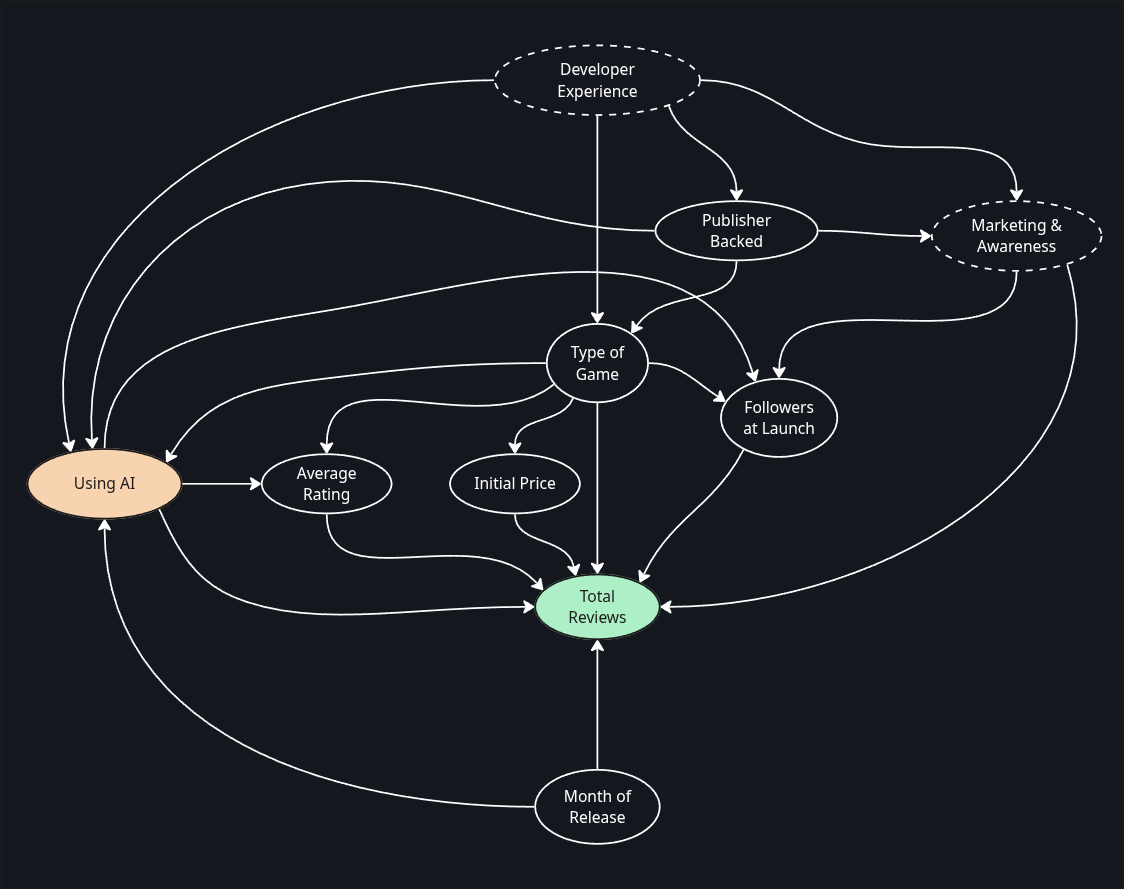
One look at our diagram above and you're probably thinking "oh, I get it, so you had a mental break right?". But please stick with us...

Our causal diagram is just a visual way of saying "here is what we think impacts sales and also impacts whether a developer uses AI". Each arrow is saying "I assume X has some causal effect on Y". The orange circle represents whether AI was used in development or not and the green circle is the outcome i.e. the total number of reviews received in the first month post-release.
We think using AI will impact the average rating a game gets and the total number of reviews. Whether someone uses AI will be influenced by:
- The developer's experience - less experienced devs might rely on AI more for example
- Whether the title is backed by a publisher - there have been some pretty strict policies introduced around AI use by publishers1,2
- The month that the game was released - in our last blog we showed how adoption is increasing over time
The total reviews is influenced by a number of factors:
- The month of release - we all know there are seasonal effects on Steam
- The number of followers a game has pre-release which is a proxy for wishlists - like with sales, no one knows the true number of wishlists prior to launch other than the developer and Steam
- Marketing, of course
- The initial price - the price of a game varies greatly over time with discounts and price localisation being major factors. Unfortunately, we don't currently have a reliable method to measure all this variation so we assumed that the initial price sufficiently influences the impact of both discount and price localisation in such a way that including initial price is enough.
- Average rating - poor reviews out-the-gate are going to severely impact sales and therefore total reviews
- The type of game created - we can actually describe this in extreme detail thanks to our Steam Map
Okay, so we have this complex diagram that describes all our assumptions, but how do we actually answer our question?
Without turning this into a statistics lecture, a Causal Graph like this allows us to use a logical framework called "do-calculus." This tool helps us identify the minimum number of factors we must measure to remove bias from our results.
This is crucial because of confounders: outside factors that influence both whether a developer uses AI and how many reviews they get. If we don't account for these, our estimates will be wrong. Our analysis revealed that to get a fair comparison between declaring AI and not declaring AI, we must control for Developer Experience, Publisher Backing, Type of Game, and Month of Release.
So, our complex math problem simplifies into a clear question:
For the same type of games, released within the same month, with the same publisher backing status and developer experience, what is the total impact of using AI on the number of reviews received in the first month after launch?
Measuring Developer Experience: Total Previous Steam Releases (TPR)
One last thing for full transparency. We cannot explicitly measure developer experience, we simply do not have the data. However, what we can do is measure how many games a developer has released on Steam (TPR), which is a nice proxy for experience.
This is of course not perfect, studio teams change, developers might have many unpublished projects outside the Steam ecosystem, and some studios rebrand. This is a limitation of our study and TPR is the best proxy we have. Ultimately, we think experience is such an important factor that we had to include a proxy for it. We actually addressed this limitation in our statistical modelling by essentially telling our model "hey, number of prior releases is a noisy approximate for developer experience, so be careful". We also did lots of work to test 'unmeasured noise', but more on that later.
Using TPR did introduce another tricky issue though – slop. There are of course spammy/scammy developers on Steam that publish tons of games, commonly referred to as slop, without placing much, if any, effort into the individual titles. This breaks our assumption that TPR is a good proxy of experience and that experience improves the likelihood of increased sales and total reviews. It also made the maths near impossible!
We mitigated this however by filtering "slop" out of our dataset based on publication frequency and absurd initial prices (>$100; there is a little over 100 games in this group and most are scams). We removed developers whose historical publication rate is greater than 1 game per every 6 months working under the assumption that:
- Any decent game, at least for commercial release, requires at least 6 months for ideation, development, testing, polishing, and publishing
- Other platforms like Itch exist for rapid prototyping, whereas Steam with its $100 entrance fee, is not the place for prototyping, training projects, and other small non-commercial releases (remember we're removing free-to-play games from our analysis anyway)
- Your average developer/ studio, with the intention of a successful commercial release, will dedicate at least 6 months to any given title
This, like anything in a statistical study, is not perfect because of course there are exceptions. Take the Sokpop Collective for example – a band of developers that has historically published ~1 game per month by working together on their releases – they're not producing slop, they just have a uniquely brilliant business strategy. They're an outlier though and for the purpose of this analysis we want to focus on the majority. Overall we removed 1932 titles from our analysis from developers with an unusually high publication rate and bizarre initial prices.
On the face of it, AI appears to be a problem
After filtering out spam and focusing on purely commercial releases between January and October 2025 we had 9879 games for analysis. Amongst these games, 17.9% had an AI declaration.
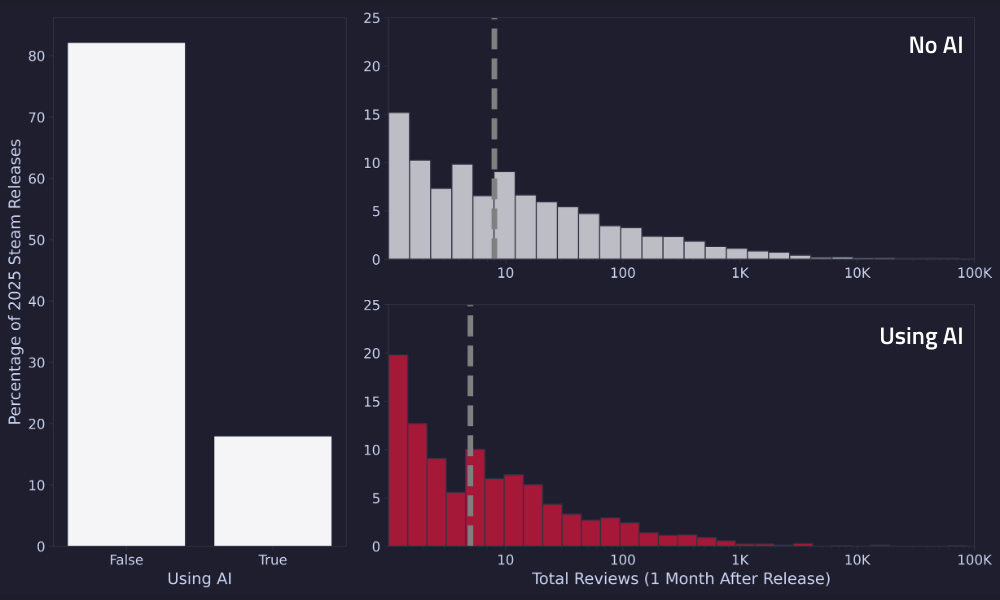
Before we dive into the results of our statistical model, a quick visual analysis shows that using AI is correlated with slightly lower total reviews, a higher proportion of 0 reviews and a higher proportion of less than 100 reviews:
| Metric | Games Using AI | Games Not Using AI |
| Median number of reviews | 4 | 7 |
| Games with 0 reviews | 19.8% | 15.2% |
| Games with less than 100 reviews | 91.7% | 94.9% |
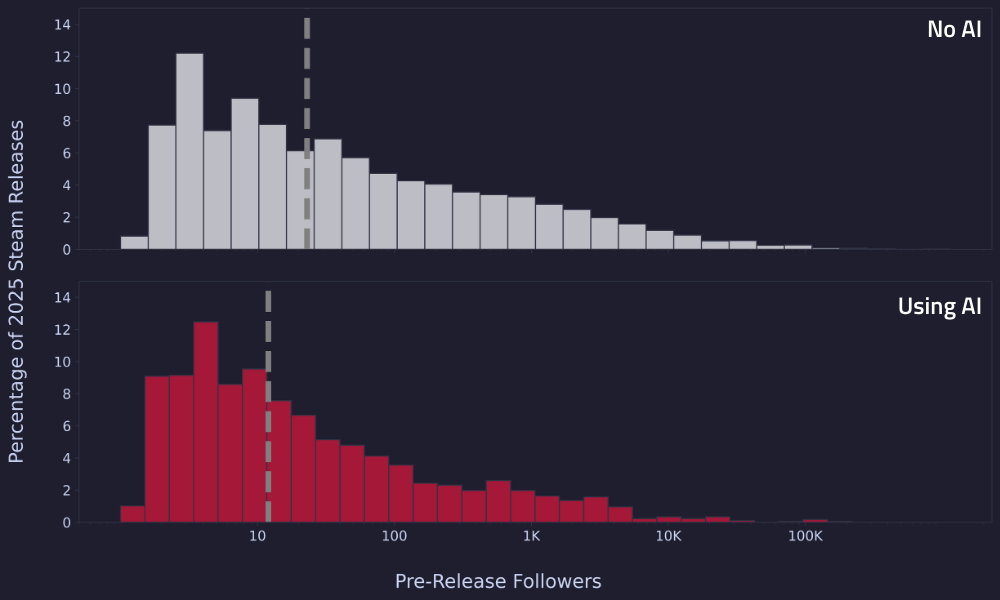
The same pattern can be seen for followers (our proxy for wishlists) where the median number of followers for a Steam game using AI is half that of games that do not use AI.
What about player reception? Well, when focusing on games that receive at least 100 reviews (to ensure that review scores are somewhat reliable) the median % of positive reviews is 84.6% for games using AI compared to 88.3% of games not using AI.
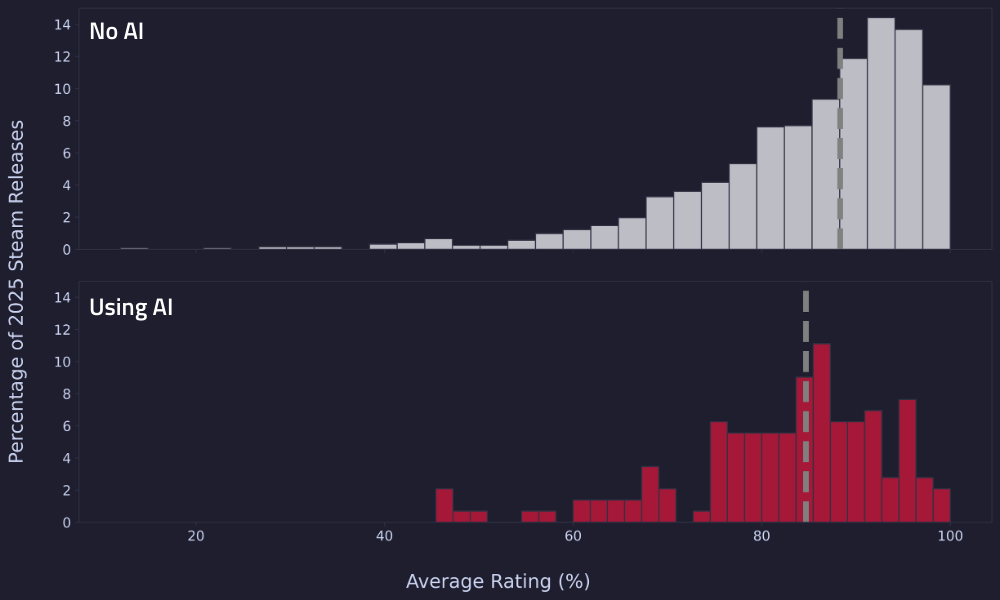
All of this implies that using AI is at least correlated with poorer performance on Steam.
We Can Go Deeper
We don't want to simply talk about correlations though, we want to know for certain whether using AI is impacting sales. To answer our specific question, we took our control variables from before (developer experience, publisher backing, type of game, and month of release) and we built a statistical model to ask:
For the same type of games, released within the same month, and with the same publisher backing status and developer experience, what is the total impact of using AI on the number of reviews received in the first month after launch?
Our results were huge. If you took two developers (A & B in the infographic below), each producing the same type of game, with the same publisher backing or true 'indie' status, with the same level of experience and releasing their game in the same month, you could expect a 52.6% (47.69% - 57.63%) decrease in total reviews for the developer that used AI compared to the developer that did not. That means if the developer that didn't use AI (developer A) got 100 reviews for their game we would expect the developer that did use AI (developer B) to only get 47 reviews despite making a similar game under similar circumstances.
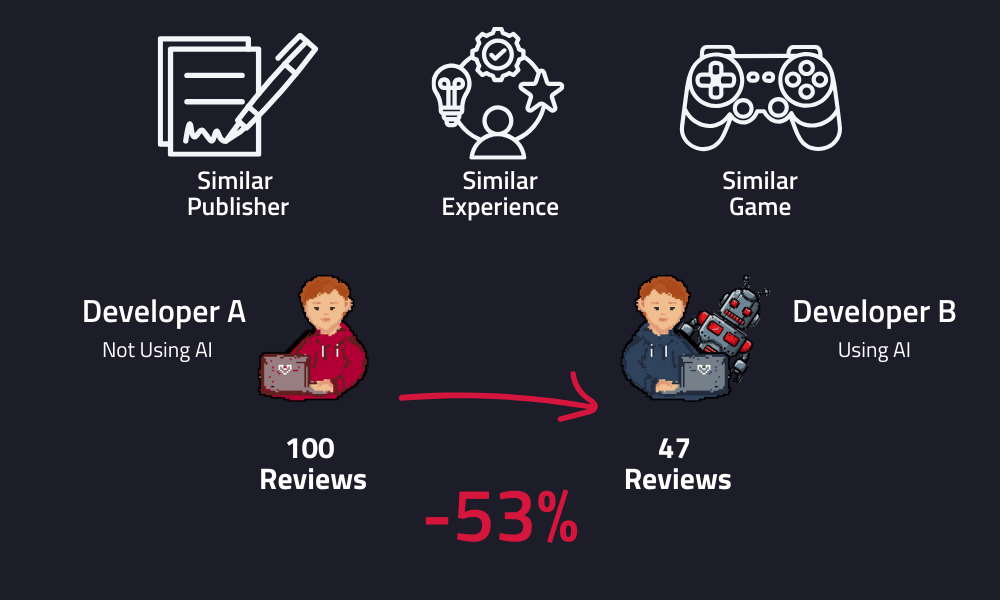
The results here really surprised us, after our initial visual exploration we expected some impact, but a developer expecting half the number of reviews (and therefore sales) due to AI use is dramatic.
Our model explained some other reassuring, and pretty obvious effects, such as developer experience and publisher backing having a large positive impact on total reviews. The type of game created could also slightly increase/decrease total reviews, and to a lesser extent the time of the year that the game was released. For example, there is a small dip for games released in the summer.
But the biggest effect was the use of AI, second to only one other thing: noise. Our model was pretty noisy. Remember before in our causal diagram that we mentioned the influence of "marketing & awareness". We also said up-front that our measure of developer experience is imperfect. All of this creates unmeasured variance which could bias our results.
But What About Skill, Talent, Marketing, and Just Plain Old Luck?
You would be right to be sceptical. We all know that some games just have an "X-factor" or find themselves in the right place at the right time. We also know that some games do everything right and the developer is just incredibly unlucky. We created our model with this "X-factor" in mind and chose something called a "Negative Binomial" model. This kind of model can measure the amount of randomness our data cannot capture — we will call this "alpha".
In our model results, alpha was positive (0.23, to be exact) which means there is quite a bit of randomness that we can't explain. If our model was perfect and we knew everything about a game, alpha would be close to zero. Essentially, this confirms that two games can look identical on paper (same genre, same AI use, same publisher status), yet one might get 10 reviews and the other 1,000 with no apparent explanation.
What does this mean for our results? Well, if that "X-factor" happens to be something that is correlated with using AI, for example studio resources, it would bias our results. Say for example developers using AI just so happen to have a low budget and a tight schedule, then it would look like AI is negative influencing sales when in fact the game just suffered due to the low budget and time pressures which then caused lower sales. There are a bunch of unmeasured things that could explain the reduced sales in fact:
- Marketing
- Developer Skill
- Financial pressures and resources
- Luck
All is not lost though. There is a special type of tool called "sensitivity analysis" which allows us test whether our result of a ~53% reduction in sales due to AI is robust or is just a result of all these other complex factors.
Essentially, what we do is simulate a world where we can measure the impact of some unmeasured "X-factor" and then we test how our estimated impact of AI on sales changes in these new hypothetical worlds. You can think of this "X-factor" as the mixed effect of all the stuff we can't measure: marketing, skill, luck etc.
On the heatmap below we have two axes describing the effect of our "X-factor":
- The X-axis shows the hypothetical effect our "X-factor" has on the odds of using AI, from no effect (1.0x) to more than quadrupling the likelihood that AI tools are used (4.5x); if the "X-factor" was developer skill for example, you could interpret this as "the most inexperienced developers with less skill are 4.5x more likely to use AI"
- The Y-axis shows the hypothetical effect of our "X-factor" on review counts, from highly negative (-39%) to highly positive (+65%); again, if the "X-factor" was developer skill, we would could read this as "being highly skilled has a positive impact on reviews (up to 65% more reviews) whereas being low skilled has a negative impact (up to 39% less reviews)
Each cell shows the new effect AI would have on the total number of reviews as a percentage if we lived in these hypothetical worlds.
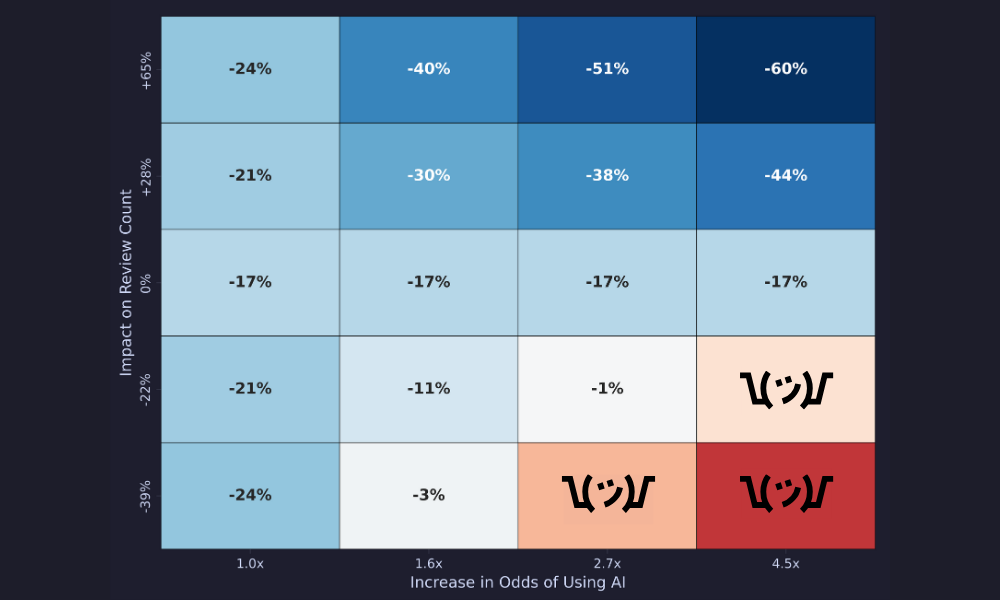
Overall, our results show our findings are moderately robust; AI does decrease reviews by ~53% overall. To explain away the observed penalty, an unmeasured X-factor would need to be strong enough to nearly triple the odds (2.7x) of AI adoption while simultaneously causing a 22% reduction in review counts, independent of publisher backing and developer experience — these scenarios are the red ones with the shrugging emojis.
In fact, this analysis highlights another critical finding. If we assume this unmeasured "X-factor" is some combination of skill, talent, marketing, and resources, which naturally get more reviews, the estimated penalty of using AI becomes more severe!
In plain terms, under the assumption that some unexplained bias is driven by experience, competence, and marketing, we can imagine two different scenarios:
Scenario 1: The Inexperienced Developer With No Resources
This developer has no budget and no experience, so they turn to AI to help with their first Steam project. Because they are inexperienced and haven't developed the skills necessary to create a great game yet, their game was likely going to sell poorly anyway (e.g., -22% to -39% fewer sales). If this narrative is true and the only reason AI games sell poorly is because they're "bad" to begin with, then AI use likely has NO impact on sales (0% change). This is evidenced by the white & red cells (near -22% "X-factor" impact simulation). The penalty disappears because the model re-attributes the failure to "inexperience" and not the use of AI itself.
If you are already an inexperienced developer with no marketing, using AI likely won't hurt you further — but it won't save you either.
Scenario 2: The "Experienced / Good Marketing" Developer
This is a "Good" well-established studio. They have talent, budget, and know-how (factors that usually boost sales by 20% - 65%). They decide to experiment with AI to optimise their workflow. If this narrative is true — if "good" studios are using AI — then AI use is catastrophic (-40% to -60% drop in sales). This is evidenced by the dark blue cells at the top of our heatmap.
If you are an experienced developer with good marketing, AI use could be harmful. Why? That is a much harder question to answer, and there was simply too much noise in our data to find what 'mediates' the decrease in sales. But the data clearly and definitely suggests a drop in sales, for some unknown reason, is expected.
Overall, our data suggests that for low-quality games, AI makes no difference. But for high-potential games, the "AI Stigma" is real and severely punishes developers who otherwise would have succeeded.
TLDR: AI Is Neutral For Beginners But Problematic For Experienced Devs
We've presented a lot here and we know there is a lot to unpack. We must also stress, that due to the unmeasured effects of marketing, skill, resources, and experience, our results could still be biased. But we are certain of one thing, for many developers the effect of using AI is currently a net negative.
We also know this flies in the face of some reports of certain AI games performing really well3 and we don't want to dismiss those success stories. Examples like The Finals4, Suck Up!5, and The Great Rebellion6 show that AI games can be commercially successful. However, they also highlight the nuance around how AI is used. In each of these titles AI usage served a clear gameplay function rather than just cutting costs or was used in a way that improved core gameplay and was unnoticeable after polish. This brings us to a clear limitation in our study; we couldn't include how AI is used. AI can be used well, or it can be sloppy, and that matters. You only need look at the controversy around COD Black Ops 7 and Jurassic World Evolution 3 to see how 'ungraceful' AI adoption can hurt a brand7,8.
Our analysis leaves us confident that AI use, on average, has a negative impact on sales for games that would have been a success regardless of whether AI was used or not. What exactly causes that negative impact? We don't know. Some might be inclined to quickly jump to conclusions and claim it's consumer backlash, with players actively rejecting games that disclose using AI. But there are plenty of other factors at play.
Using AI for game development might be a symptom of some wider mechanism that is impacting the quality of games. Why does a studio choose to use AI? The narrative seems to be that AI is used due to social and economic pressure, to cut costs, and to ship faster. We have yet to see a convincing example of AI making games "better" than those that are created purely by human engineers and artists. It seems fair to assume then that using AI is simply correlated with other decisions that lead to a poorly crafted game, i.e. trying to take shortcuts.
Speaking personally, as a data scientist and someone that has been toying with stats, data, models, and "AI" for nearly a decade now. My guess would be that it is the way AI is used that matters most. I would hope that AI is ultimately a force for good. A tool that frees game developers from some of the brunt work so they can focus more on the important creative decisions, but maybe more importantly, so they can escape "crunch" culture and gain a better work-life balance. So far, it seems that AI is increasing our work, not decreasing it. AI is being used as an excuse to cut costs, cut teams, and bring deadlines forwards, and maybe that is what makes the end product suffer.
So what is our conclusion? AI is a tool, it should not be avoided. Would you avoid using a hammer to build a shed? No, of course not. Just don't go around hitting everything with it. Approach AI with caution. Use it gracefully. It is not a replacement for hard work, it's just there to lighten the load.
References
- https://www.clydeco.com/en/insights/2025/07/ai-generated-content-in-gaming
- https://www.creativebloq.com/3d/video-game-design/how-indie-game-dev-opinions-on-generative-ai-have-changed
- https://www.totallyhuman.io/blog/games-with-ai-disclosures-have-grossed-an-estimated-660m-on-steam
- https://store.steampowered.com/app/2073850/THE_FINALS/
- https://store.steampowered.com/app/2726370/Suck_Up/
- https://store.steampowered.com/app/2732820/The_Great_Rebellion/
- https://www.forbes.com/sites/paultassi/2025/11/15/call-of-duty-black-ops-7s-awful-ai-use-is-a-watershed-moment/
- https://www.screenhub.com.au/news/games/jurassic-world-evolution-3-genai-2671001/