Are Christmas Games Worth The Risk?
Share:

Festive Fun on Steam
As the festive season gets into full swing, a question echoes in the minds of indie developers: Is it worth making a Christmas game? The allure is undeniable; a built-in theme, the chance to create something joyful, and a captive holiday audience eager for new experiences during a period of increased gaming activity. Some have observed that while we have countless Christmas movies and songs, there are comparatively few Christmas games, suggesting a potential gap in the market for developers to fill1,2.
This opportunity has not gone unnoticed and some developers have found success by embracing the season. The creator of the Christmas horror game Krampus Kills reported it as a "moderate success" that not only covered its production costs but also funded a future project. Beyond standalone titles, Christmas-themed updates for existing games have proven to be a massive draw, with some indie games seeing up to a 40% increase in daily players after launching a holiday event3,4.
But any seasoned indie dev knows that things are often more complicated. Is the market crowded? Wouldn't a Christmas-themed game have a terribly short shelf-life? What harsh financial reality might be overlooked? The median indie game on Steam, after all, earns just over $1,000 in its lifetime5, so the risks are already high before betting on the Christmas season. There are also numerous anxieties around festive-themed games echoed by developers, including timing difficulties and the lack of year-round appeal6,7.
Faced with this mix of clear opportunity and significant risk, is the festive gamble worth it? To find out, we performed an extensive analysis of Christmas-themed games on Steam. Using an in-house classifier trained on our Steam Map, we analysed these festive titles to understand what makes them tick, how they perform, and whether they represent a golden opportunity or a festive folly for indie developers.
The Landscape of Christmas Games on Steam
Steam offers a diverse world of wacky and wonderful games so it should be no surprise that there is an entire spectrum of Christmas theme games out there, from puzzles you would happily share with your Grandma on Christmas morning to truly terrifying experiences you would absolutely not want to share with the family. But how can we find all the relevant Christmas games for our analysis?
If you've read our work before you'll be aware that we discourage the use of simple keywords and user-defined tags when finding relevant games in your market research. Instead, we have built a map of the Steam marketplace that groups similar games together based on their store page descriptions, images, and meta-data, powering state-of-the-art market search capabilities.
Using our Steam map we identified 434 Christmas-themed games on Steam which we then grouped into categories based on their mechanics, visual art styles, and general theme.
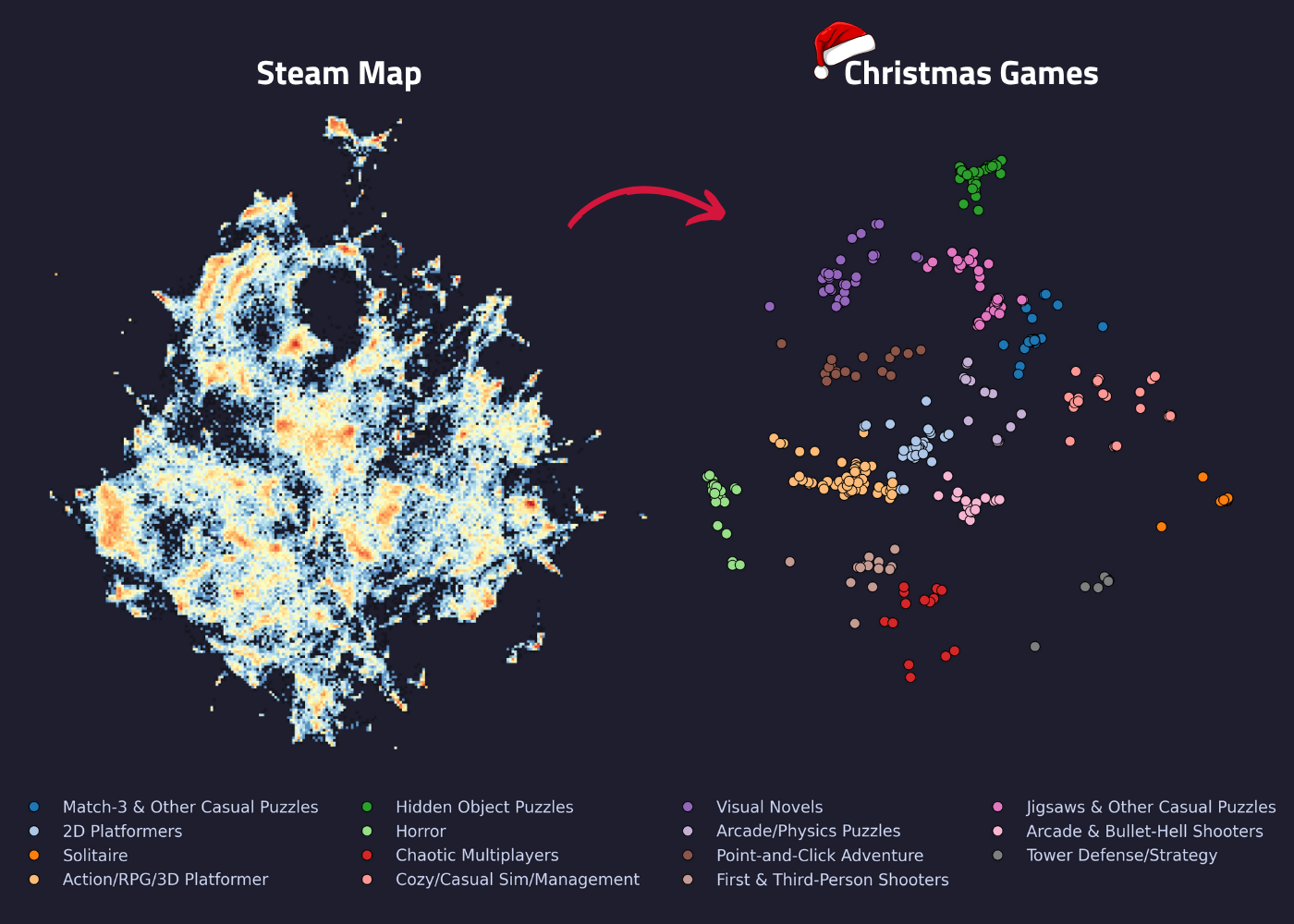
As you can see there is plenty of diversity amongst Christmas games, showing game developers are certainly not short of creativity! But how well do games perform in each of these segments?
How well do Christmas games perform?
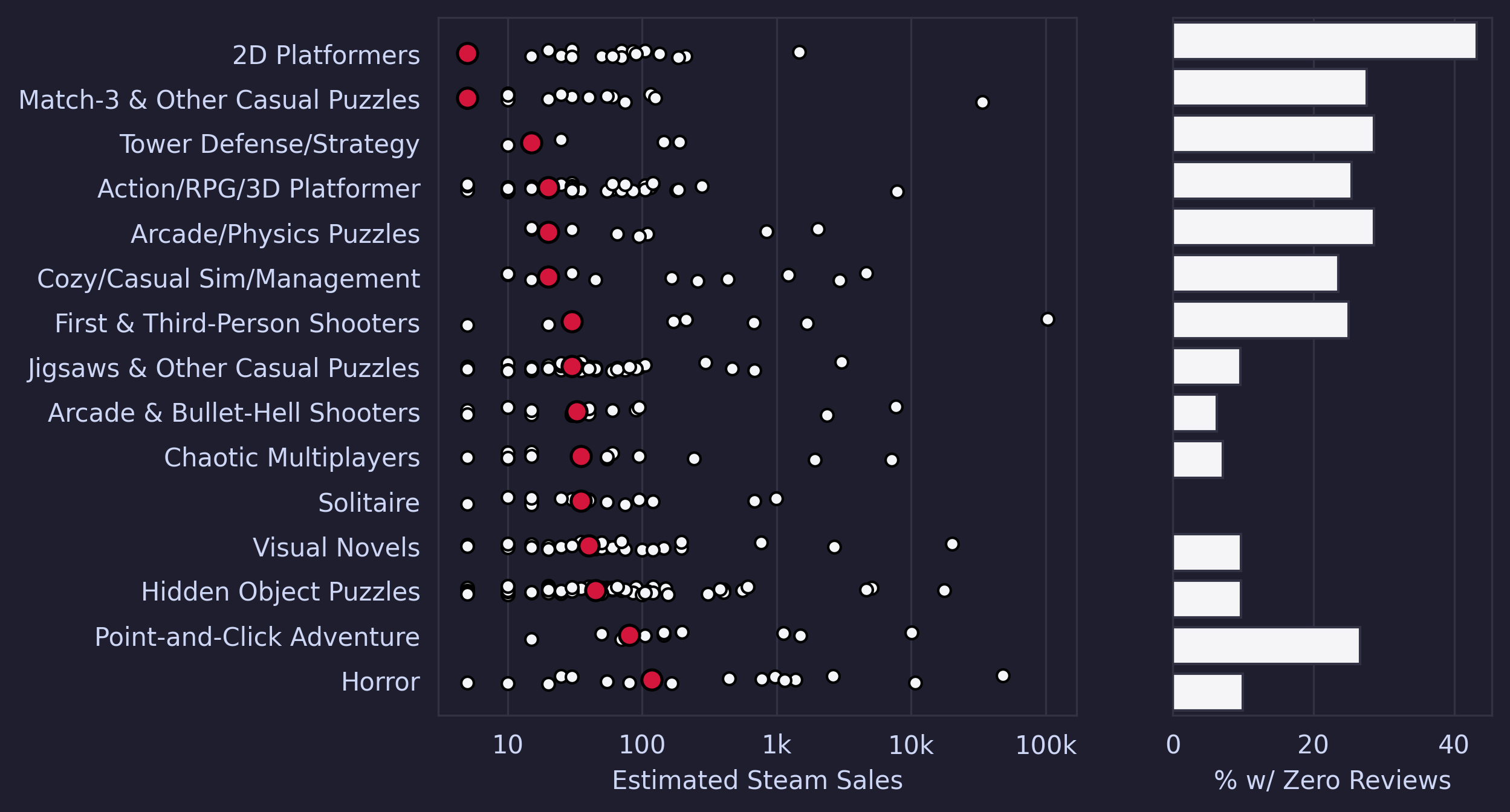
On average, Christmas games achieve an estimated 30 Steam sales, which is lower than the overall Steam average of 45. However, our analysis reveals a clear divide between genres that thrive during the holiday season and those that get lost in the snow. For developers weighing the risks, understanding these trends is crucial.
Some genres appear to be particularly difficult sells; our data shows that 2D platformers, Match-3/Casual Puzzles, and Tower Defense/Strategy games make up the lowest performing segments. These genres not only have the lowest median estimated Steam sales, but also contain the highest proportion of games with zero reviews.
This suggests a market saturated with titles that fail to capture player attention, possibly because the seasonal theme isn't enough to stand out in already crowded categories. For a developer working in these genres, a Christmas theme may not be a differentiator but rather an additional constraint that limits the game's long-term appeal.
On the other side of the spectrum, a few key genres have consistently found success. Hidden Object Puzzles, Point-and-Click adventures, and Horror emerge as the top-performing segments.
Hidden Object and Point-and-Click games cater to a dedicated casual audience that is often actively looking for new, relaxing experiences during the holidays. The Horror genre's success might seem counterintuitive, but it thrives as effective counter-programming to the season's typical cheer. Christmas horror taps into a rich vein of folklore and provides a memorable, high-contrast experience that stands out. In fact, Horror games in our dataset significantly outpaced the struggling genres in terms of average sales performance.
While genres provide a useful map, some of the most interesting lessons come from the games that defy expectations. These outliers demonstrate that a unique vision, a clever genre blend, or a well-defined niche can create a holiday hit.
- Merry X-Merge (Match-3/Casual Puzzle): While the Match-3 category generally underperforms, Merry X-Merge stands out as an exception. The game elevates the standard formula by incorporating merge mechanics and a light-hearted story of saving Christmas. Its success highlights a key lesson: even in a saturated genre, high-quality presentation, polished mechanics, and a charming narrative can win over players. It isn't just a Christmas-themed puzzle game, it's a well-crafted experience that uses the theme to its full potential.
- Christmas Nightmare & Christmas Massacre (Horror): These two games exemplify why the horror genre performs so well. Christmas Nightmare is a short, atmospheric psychological horror experience that plays on the fear of being alone during the holidays. Christmas Massacre takes a different approach, offering a retro, 8-bit slasher experience where you play as a killer Santa. Both games succeed by committing to a strong, specific horror fantasy that is amplified, not limited, by the Christmas setting.
- Sakura Santa (Visual Novel/Adult): Visual Novels are a niche genre, and adult games even more so. Sakura Santa is a title from the well-known "Sakura" series, which has a large, established fanbase. Its outlier status shows the power of serving a specific, dedicated community. For its target audience, the combination of a familiar series, a dating-sim visual novel format, and a festive theme is a compelling proposition that operates outside mainstream trends.
- Christmas Adventure: Candy Storm (Hidden Object Puzzle): A prime example of a game succeeding by excelling within a top-performing genre. As a Hidden Object Puzzle Adventure (HOPA), it delivers exactly what the genre's fans want: festive scenes to explore, engaging puzzles, and a low-stress, cosy story. Its success isn't about reinventing the wheel but about executing a proven formula with polish and charm for a receptive holiday audience.
- SOUTH PARK: SNOW DAY! (Third-Person Shooter): This game is an outlier for one major reason: the power of a massive, globally recognised franchise. Unlike an indie title, SOUTH PARK: SNOW DAY! entered the market with enormous brand awareness. While it's Christmas-adjacent "snow day" theme is a factor, its performance is overwhelmingly driven by its connection to the South Park IP. It serves as a stark reminder of the different commercial realities faced by indie developers versus major franchise releases.
- Cthulhu Saves Christmas (JRPG): This title is a masterclass in genre-blending and humour. It combines the unlikely duo of Lovecraftian horror and Christmas cheer, wrapping it all in the mechanics of a 16-bit JRPG. From the creators of Cthulhu Saves the World, the game leverages a pre-existing fanbase for its quirky style. Its success proves that a truly unique and well-executed concept can find a passionate audience, turning a bizarre premise into a beloved holiday cult classic.
The Wishlist Challenge: Can Upcoming Christmas Games Build Pre-Launch Momentum?
For many indie developers, Steam wishlists are the lifeblood of a successful launch. They signal genuine player interest and provide a rough prediction of how a game might perform in its crucial first week. But for Christmas-themed games, the question becomes even more pressing: can a festive title generate meaningful wishlist numbers when its appeal is so tightly bound to a single season?
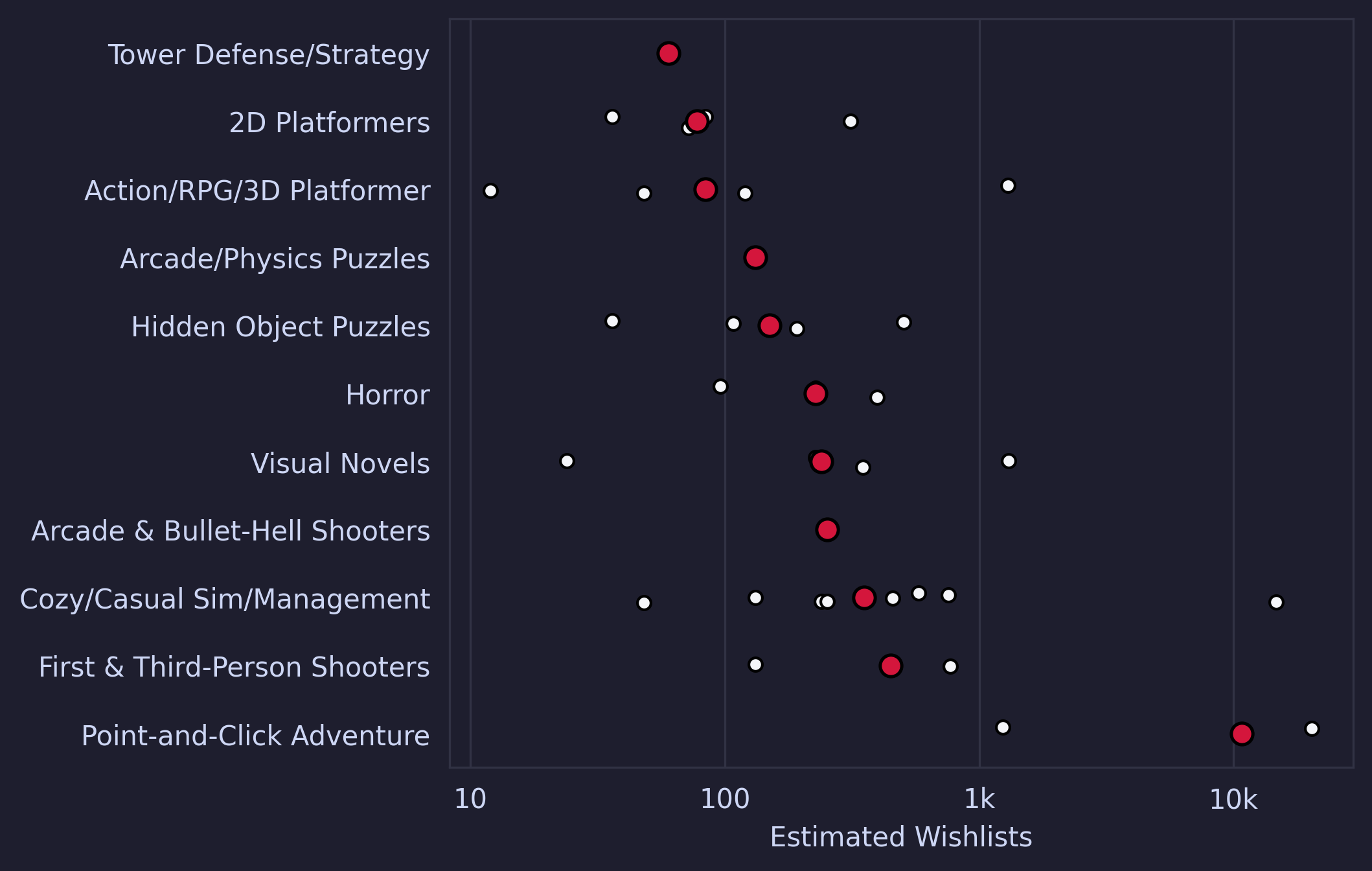
As shown in our analysis, the vast majority of unreleased Christmas games gather between 300 and 900 wishlists. For context, in 2025, around 66% of all Steam games launch with fewer than 10,000 wishlists, and only 6% manage to cross the 100,000 threshold, where the likelihood of commercial success increases significantly. For Christmas games, which face the additional challenge of a limited shelf-life, breaking through the noise is even harder.
However, two notable outliers demonstrate that it's not impossible. Moomintroll: Winter's Warmth is one such example. The game benefits from the beloved Moomin franchise, which has a dedicated international fanbase built over decades of books, television series, and films. This pre-existing IP recognition gives it a significant advantage in wishlist acquisition, as fans of the franchise are already primed to support a new Moomin experience, regardless of its seasonal theme. The franchise acts as a powerful marketing engine that most indie developers simply don't have access to.
The other standout is Light Up The Town, a game that has managed to generate substantial wishlist numbers without the crutch of a major franchise. This is particularly impressive and suggests that the game has tapped into something resonant, whether through compelling gameplay, strong visual presentation, effective community engagement, or a combination of all three. Its success serves as a reminder that while the odds are stacked against Christmas games, a well-executed concept with clear appeal can still cut through the clutter. For indie developers, Light Up The Town offers a more realistic model to study than a franchise-driven hit like Moomintroll.
When Should You Launch a Christmas Game? Timing and Release Patterns
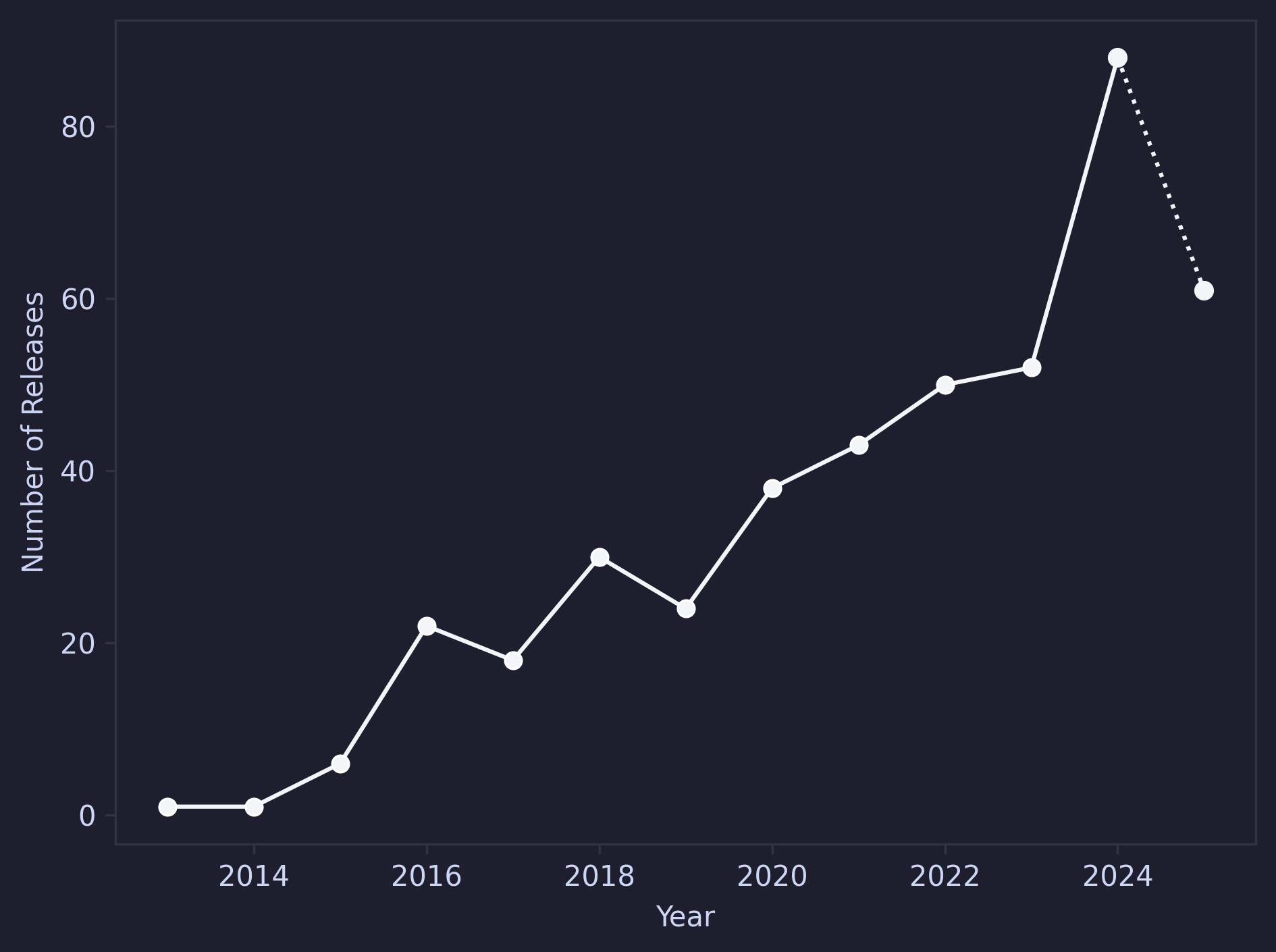
The volume of Christmas-themed game releases on Steam has been steadily climbing over the years, mirroring the broader trend of exponential growth on the platform as a whole. In 2024, Steam saw nearly 18,600 total game releases, and Christmas games saw a similar surge. 2024 was particularly busy for festive releases, with developers seemingly eager to capitalise on the holiday market. 2025 appears to be more subdued by comparison, though it's important to note that our data for this year remains incomplete, as many developers may still be preparing their games for a late-year launch.
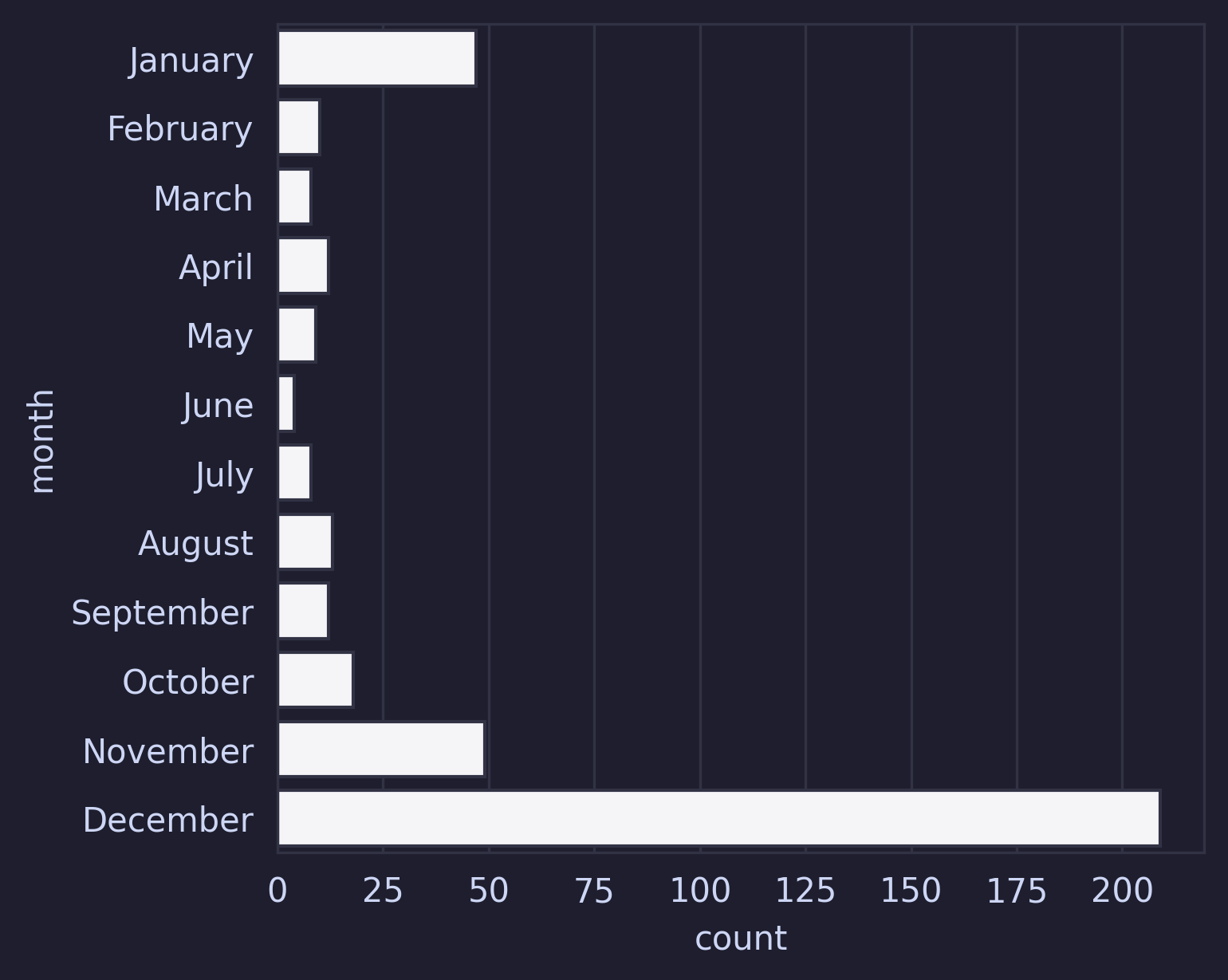
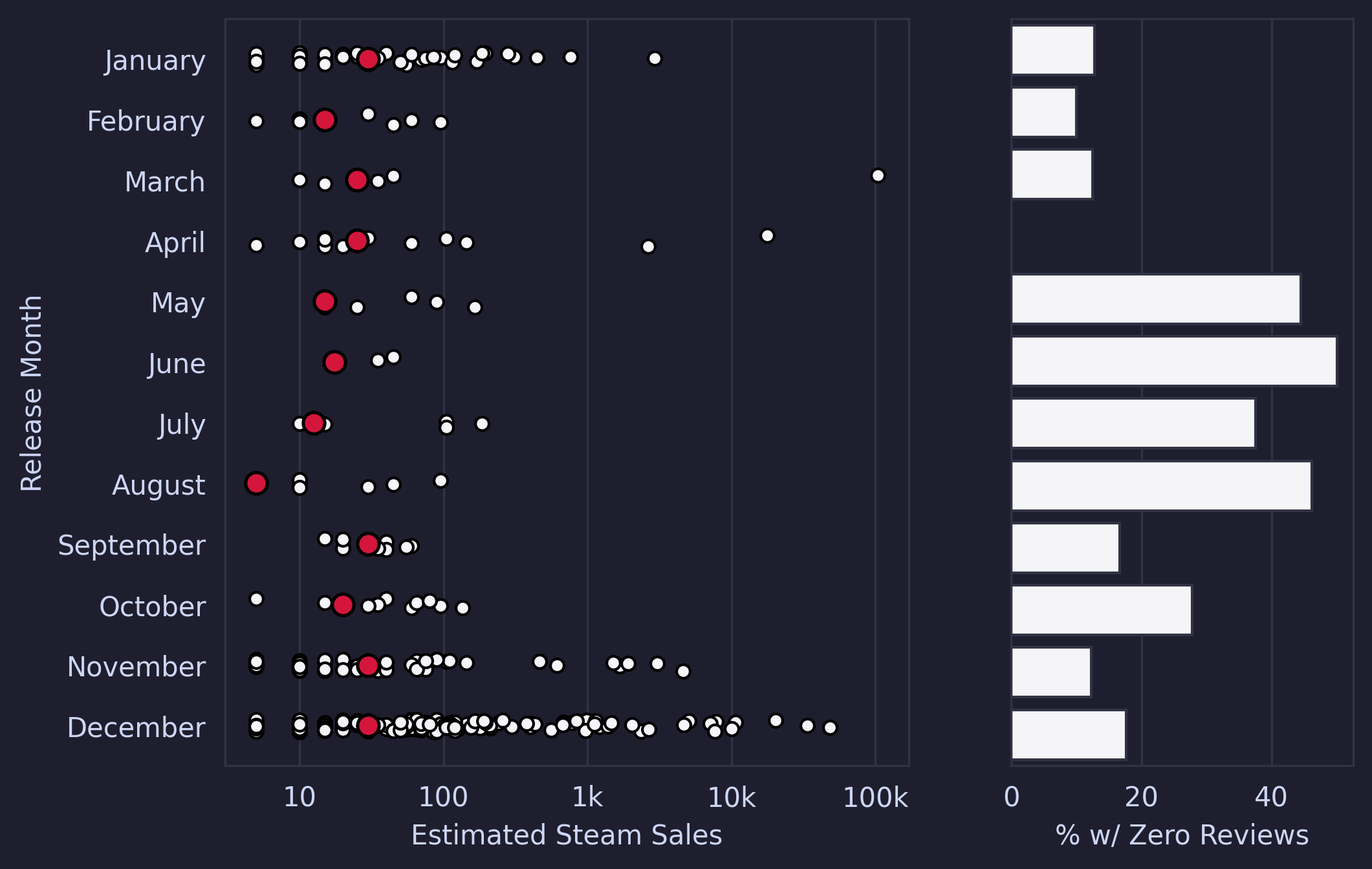
Unsurprisingly, the vast majority of Christmas games are released in the run-up to the holiday season, typically between October and December, when player interest in festive content peaks. This strategic timing aligns with consumer behaviour during the holiday shopping period and maximises visibility during Steam's high-traffic winter sale events. However, a curious pattern emerges when examining games released outside this window: a number of developers choose to launch their Christmas titles in the summer months. The reasoning behind this counterintuitive strategy is unclear. It's possible these are student projects released at the end of an academic year, non-commercial passion projects, or experimental titles developed during game jams. Whatever the motivation, the data tells a harsh story, games released during the summer months have a disproportionately high rate of zero reviews, suggesting they fail to gain traction with players who are simply not thinking about Christmas in July.
That said, there are always exceptions. SOUTH PARK: SNOW DAY!, a major franchise title, launched in March 2025 and performed well despite being far removed from the holiday season. Its success, however, is clearly driven by the power of the South Park brand rather than any strategic timing around its winter theme. More intriguingly, two indie titles, Christmas Adventure: Candy Storm and Christmas Night, both released in April and still managed to find commercial success. These outliers suggest that while timing is important, a strong game with the right genre fit and marketing execution can defy conventional wisdom. For most developers, though, the data is clear: if you're making a Christmas game, aim for a fall or early winter release to give yourself the best chance of success.
What do the players say about Christmas games?
Beyond the numbers, we wanted to understand what players actually think about Christmas games, so we analysed thousands of Steam reviews to uncover what makes these festive titles succeed or fail.
Players are drawn to Christmas games primarily for their cosy, festive atmosphere and the emotional connection they provide to the holiday season. The relaxing, accessible gameplay, whether hidden object puzzles, match-3 games, or casual management sims, offers stress-free entertainment perfect for unwinding during the holidays. Players also appreciate charming visuals, particularly nostalgic pixel art and cute characters like cats and Santa, as well as the satisfying sense of progression through levels, unlockables, and building mechanics. Short play sessions and affordable price points make these games feel like low-risk seasonal treats that deliver good value.
The most frequent criticism is that Christmas games often feel repetitive and lack innovation, with developers relying too heavily on the festive theme rather than delivering genuinely engaging mechanics. Technical issues plague many titles, including bugs, crashes, poor controls, unoptimised performance, and clunky interfaces that undermine otherwise enjoyable experiences. Players also criticise games that are too short without meaningful replayability, poor writing quality with grammatical errors or weak narratives, and aggressive monetisation tactics like pay-to-win mechanics and artificially difficult levels designed to encourage spending.
Christmas games succeed when they deliver a cosy, festive escape with accessible gameplay and charming presentation, but they fail when the holiday theme becomes a substitute for substance. Players quickly recognise low-effort asset flips and cash grabs, leading to high rates of zero reviews for titles that prioritise seasonal aesthetics over quality. For developers, the key to success lies in balancing seasonal charm with genuine gameplay quality, polish, and innovation, proving that a Christmas theme alone isn't enough to win over Steam's increasingly discerning audience.
Hidden Gems: Quality in Under Saturated Markets
While commercial success often correlates with following established genre formulas, several Christmas games have earned strong player approval by doing something genuinely different. These titles scored low on our Saturation Score metric (meaning they occupy less crowded creative spaces) and demonstrate that originality can win hearts even when it doesn't immediately translate to sales.
Everybody Wham Wham stands out as a story-driven winter adventure centred around a snowman-building competition. Developed by Bonte Avond and released in January 2021, the game combines social gameplay with sabotage mechanics as players compete to create the best snowman at a festival. What makes it unique is its narrative focus. Players make friends, tune into the in-game Wham Wham Radio Station, and uncover a hidden mystery behind "Wham Wham the Snowman-man". The game earned a very positive review score, with the developers noting they took it from prototype to release in just three months. Its combination of cosy festival atmosphere with competitive sabotage mechanics creates a distinctive experience that feels fresh within the Christmas game landscape.
SantaCraft takes the Minecraft-inspired building genre and applies it to Christmas town construction. Released in December 2020 by Milkbag Games, it allows players to build and customise their own festive villages, offering creative freedom within a seasonal framework. While building games are common, the specific focus on Christmas town creation occupies a niche that few other titles explore, giving players who want to design their ideal holiday setting a dedicated space to do so.
No More Snow flips Christmas cheer on its head with a co-op shooter where players battle Christmas monsters across 16 unique levels. The game takes players through high mountains, forest paths, deep caves, graveyards, and spooky towns, offering a variety of firearms and melee weapons to face hordes of enemies and bosses. What sets it apart is its laid-back approach to the horde shooter genre; it doesn't take itself too seriously, embracing the absurdity of fighting Christmas creatures while maintaining accessible, fun gameplay.
Snowball! is a charming, casual 2D retro pinball game where players guide colossal snow spheres through a whimsical, homemade winter maze, emphasising discovery and high scores. Snowball! reimagines classic pinball as a charming, kid-powered winter adventure. Its unique "hand-cranked" DIY aesthetic is central to the level design, featuring imaginative obstacles like snowbanks, homemade wooden paddles, Tesla coils, igloos, and railcars.
Santa Rockstar takes the rhythm game genre and gives it a festive twist. Released in December 2016, it combines music gameplay with Christmas themes, allowing players to jam out to holiday tunes while playing as Santa. Rather than being a traditional music game with a Christmas skin, it fully commits to the rockstar Santa concept, creating a playful, energetic experience that contrasts sharply with the cosy, relaxed vibe of most Christmas titles. This genre-blending approach helps it occupy a less saturated niche within the Christmas gaming market.
The Verdict: Follow Your Festive Heart (But Know the Odds)
So, should you make a Christmas game? If you're passionate about bringing a festive vision to life, absolutely... but go in with your eyes wide open.
The data doesn't lie. You're entering a market where over 30% of games in struggling genres never get a single review, the median Christmas game barely scrapes past 100 sales, and generating even 1,000 wishlists before launch is an uphill battle. You'll be competing in an increasingly crowded space (2024 alone saw over 90 Christmas releases) and most players won't even think about your game if it's not ready by October. Launch in the summer, and you're almost guaranteed to be ignored. Choose the wrong genre (2D platformers, Match-3, or Tower Defence) and you'll face the highest failure rates on the platform.
These aren't hypotheticals. They're measurable risks that should fundamentally shape how you approach development. If you're going to make a Christmas game, let the data inform your scope. Consider a tight, focused experience that can be completed in a few months rather than a sprawling project that drains years of development time. Target genres that have proven success (Horror, Hidden Object, or Point-and-Click) or commit to doing something genuinely unique in an under-saturated niche. Polish matters more than ever; players have learned to spot lazy asset flips and will punish repetitive, buggy experiences with silence.
But here's the flip side: the games that do succeed have achieved impressive sales and deliver an IP that can be revived each time the festive season rolls back around. From Everybody Wham Wham's snowman sabotage to Cthulhu Saves Christmas's genre-bending absurdity, the standouts prove that creativity, quality, and a clear understanding of what players want can break through the noise. If you've got a fresh idea, a realistic timeline, and the discipline to launch it at the right moment, the festive gamble might just pay off. Just make sure your Christmas miracle is backed by smart planning, not just wishful thinking.
References
- https://www.reddit.com/r/IndieGaming/comments/1gteptu/ive_always_felt_that_there_arent_many_good_games/
- https://www.reddit.com/r/Steam/comments/73njcw/any_good_winterchristmas_themed_games_on_steam/
- https://impress.games/blog/best-indie-game-christmas-updates-2024
- https://www.reddit.com/r/gamedev/comments/zk61sf/can_anyone_share_some_middle_ground_indie_success/
- https://gameworldobserver.com/2022/11/29/median-indie-game-earnings-steam-barely-over-1000
- https://www.reddit.com/r/gamedev/comments/18vz31m/do_holidaythemed_games_have_a_chance_of_being/
- https://www.localizedirect.com/posts/christmas-themed-video-game-updates