What if the key to success is survival?
Share:

Power Law Economics
What do real estate, venture capital, scientific publishing, and game development have in common? They're all governed by power law economics.
Vilfredo Pareto was the first public figure widely recognised for formalising this kind of relationship. He noticed that 20% of Italians owned 80% of the land. He couldn't have been thinking about video games or venture capital, neither had been invented yet, but what he documented would go on to be echoed by writers, philosophers, and economists across every domain: 20% of crops yield 80% of the food, 20% of clients drive 80% of sales, 20% of scientific publications attract 80% of citations. I could go on and on, because this pattern is seemingly everywhere.
Economists like Sherwin Rosen and Nassim Taleb formalised what Pareto glimpsed most elegantly: a handful of rare, outsized winners capture the lion's share of any market. This is power law economics, and the upside is ruthlessly concentrated in the few.
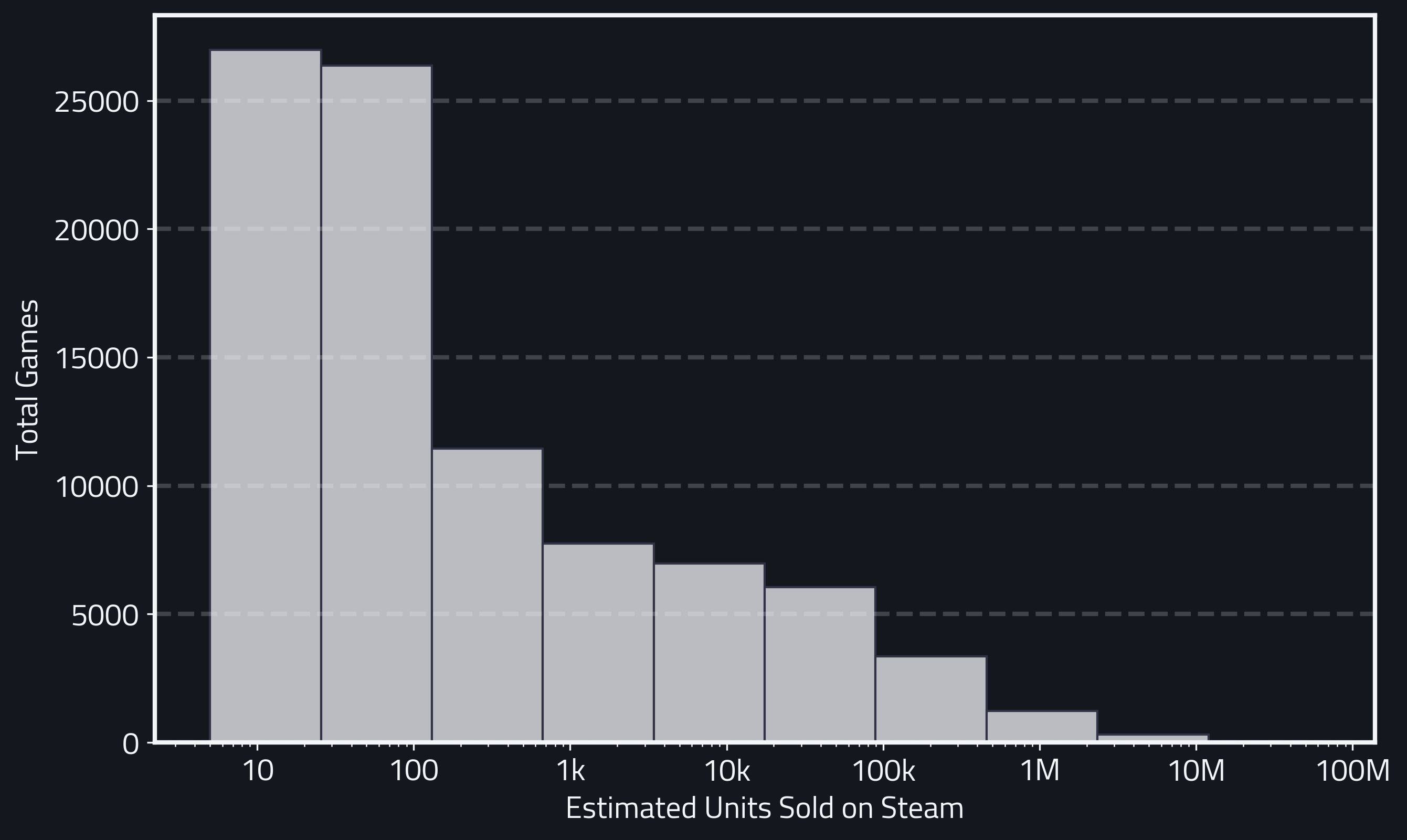
When we examine the Steam marketplace things are no different. Just 5% of games account for roughly 91.9% of all sales on Steam. A handful of developers dominate the ecosystem.
At this point, you're probably thinking, “Wow, so glad I opened this blog.”
Don’t leave yet. I’m laying this groundwork because if we understand the mechanisms driving power laws, we can actually design strategies to thrive despite the odds. It is better to be informed and optimistic than uninformed and delusional.
The Mechanisms that Drive Power Laws
The economics behind markets like Steam are complex, but there are three well-established mechanisms worth understanding closely. Together, they point to this blog's central theme: stamina and persistence.
First, cumulative advantage. When you ship your first game and survive, you walk away with codebases, marketing lists, and hard-earned knowledge you can build on next time. Persistence enables compounding, and compounding is arguably the most powerful force in any competitive system.
Second, scalability. When you sell physical goods or trade hours of your time (think doctors, lawyers, dentists) there is a hard ceiling. There are only 24 hours in a day. But digital goods have no such limit. Sherwin Rosen captured this in his 1981 paper on the "Economics of Superstars": small differences in quality or luck translate to enormous differences in outcomes, because the winner can serve the entire market at near-zero marginal cost.
Third, rare events dominate outcomes. Your first breakthrough is disproportionately hard to achieve, but subsequent wins become structurally easier. You simply have to stay in the game long enough to encounter that singular, game-changing event.
That doesn't mean everyone who persists becomes a millionaire. Those milestones are personal. But across a lifetime, our outcomes are often defined by a small handful of rare, high-impact moments.
The goal is straightforward: stay in the game long enough to land in that scalable upside. And as we'll see, the data supports this.
Most People Quit
Our first critical observation is that only 1-in-5 developers ever release a second game on Steam.
Think about that for a second. The next time you see a disheartening statistic about the thousands of games flooding Steam every month, remember that 80% of those developers will not stick around. Most of that volume is just noise. It isn't competition.
Let's visualize this. The image below shows a survival curve. I used to make these to help doctors and scientists understand how long patients survive after some event occurs. Here I’m applying the same logic but “survival” is instead “did the developer stick around and make another game”.
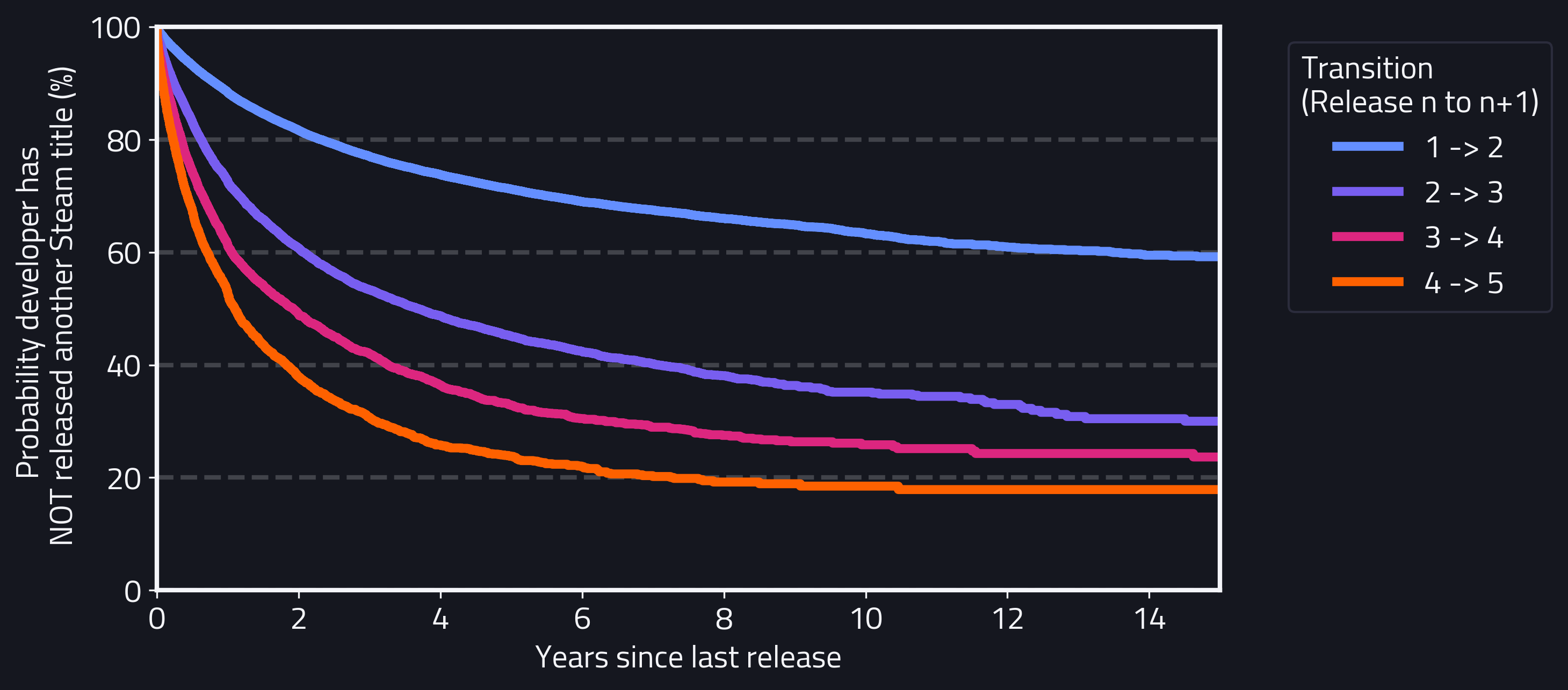
On the x-axis we see the progression of time, and on the y-axis we have the probability that a developer has not released another game. In this context, "quitting" means they haven't published a follow-up title on Steam. Since we're only looking at Steam data, there is of course the possibility that some developers moved on to other platforms instead, so bear that in mind when interpreting these numbers.
For developers who have published their first game and are working toward a second, there is roughly a 60% chance they never ship again, even a decade after their debut. Compare that to developers who have already made two or three games: the probability of not releasing another title drops to somewhere between 20% and 30%. Simply by persisting through those early releases, a developer has meaningfully improved their odds of continuing.
The hazard of quitting is highest in those first couple of years, but the longer you stay in the game, the lower your chance of walking away.
More Releases = Higher Cumulative Odds of a Breakthrough Hit
So does staying in the game actually improve your chances of commercial success? The data suggests it does. For this analysis, we define a breakthrough hit as selling 25,000 copies. For a typical indie game priced around $10, that translates to roughly $250,000 in gross revenue, a meaningful milestone by any measure.
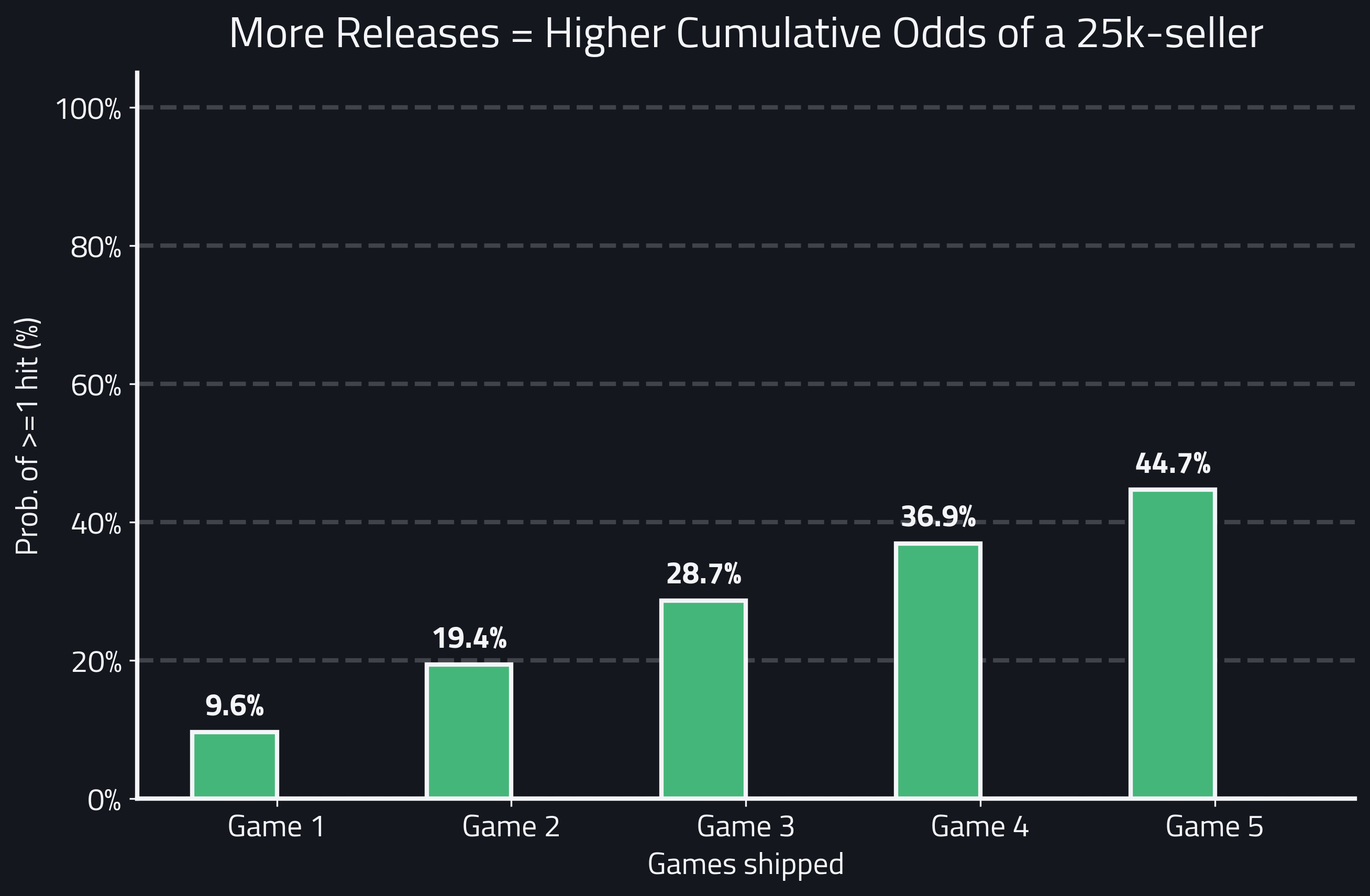
The chances of hitting that milestone on your first release sit at around 1 in 10. By your fifth release, they are closer to 1 in 2.
There is no magic that kicks in at game five. You are the magic. Those who survive are more likely to keep surviving. Those who find success are better positioned to find it again. Every release teaches you something: about your craft, your audience, your marketing, your process. The compounding is not statistical sleight of hand. It is the accumulated result of everything you have learned and built along the way.
Now, I can already hear the objection forming: "That's just survivorship bias!"
And yes, survivorship bias is real and worth taking seriously. If you asked at the very start of your career what the odds are of both surviving long enough to ship five games AND having a 25k hit by that fifth release, the honest answer is around 13.7%. We show this in the chart below, with the red bars representing cumulative odds after accounting for studio attrition.
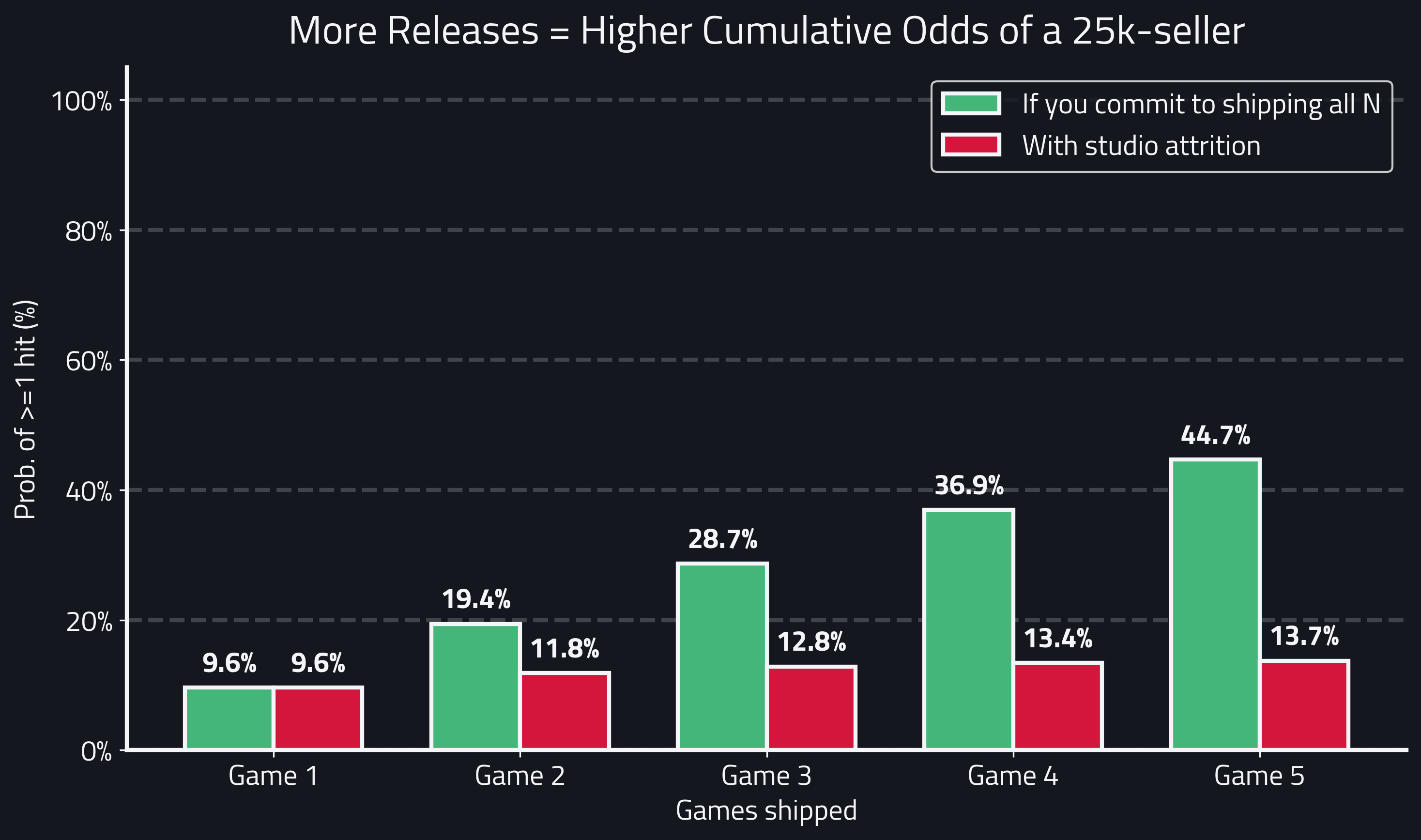
But here is the thing: survivorship bias is not a flaw in the argument. It is the argument. The gap between the green bar and the red bar is not a statistical artefact to be explained away. It is the prize that goes to those who refuse to quit. You learn, you grow, you build an audience, and you position yourself better with every release. The upside exists. You just have to survive long enough to reach it.
So, how do you survive long enough to land in the upside? How do we practically fund the dream?
The Barbell Strategy
One framework for surviving and thriving as an indie developer is Nassim Taleb's Barbell Strategy.
Picture a barbell. You load one end heavily with safe bets that keep the lights on. You load the other end with wild moonshots, allocating roughly 10 to 30% of your resources to high-risk, high-reward ideas whose upside is completely uncapped. And crucially, you avoid the messy middle: opportunities that carry real risk but offer only limited reward.
When I say resources, I mean more than money. In our context, resources are time, mental energy, and creative capacity. All of it counts.
I should be clear that what follows is our interpretation of this strategy, applied to a game-oriented business. We run Game Oracle, a market research platform for indie developers, alongside consultancy services, and we are building an indie studio. We are bootstrapping, with no external investment, but the barbell logic applies regardless of your funding situation.
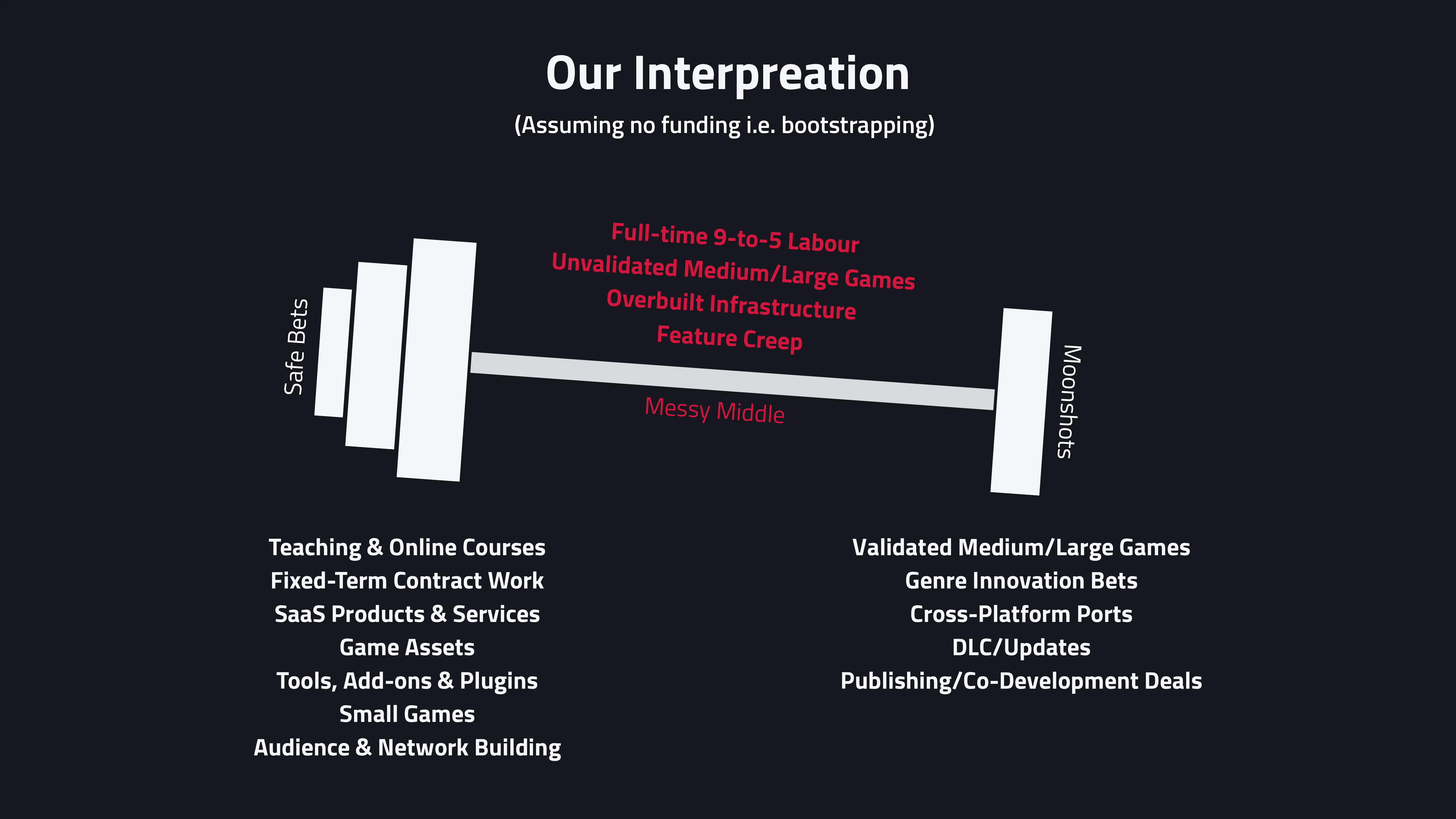
Safe bets are activities where the risk of financial ruin is low, but so too is the risk of surrendering your time entirely to someone else's dream. Some people will be surprised that I've placed full-time employment in the messy middle. But a salaried role has capped upside by definition, and spending a career selling hours you don't own can be quietly disastrous. The messy middle also includes unvalidated ideas you've over-committed to, overbuilt infrastructure, and feature creep: things with meaningful downside and limited payoff.
The moonshots are the exciting part. This is where you roll the dice. Because there is no ceiling on the upside, you only need one of these bets to pay off. That makes the risk worth taking, provided your safe bets give you enough runway to absorb the ones that don't.
One important clarification on resource allocation: this is not a daily time budget. It does not mean spending 70% of each day on safe bets and 30% on big swings — although you might do exactly this! Maybe you have a day job at the moment, your safe bet is working that job 9-to-5, and in the evening you work on your moonshot(s). That is a perfectly valid interpretation in my mind.
Our approach operates on a longer time horizon. Our market research business and contract work generate the funds to take 6 to 12 months off and pursue a moonshot. When those funds run low, we return to safer activities to top them back up.
The underlying mindset is always the same: how do we survive long enough to improve our odds?
Direct Strategies for Game Dev
There are several widely recognised methods for reducing risk when developing a game. Prominent voices in the industry have covered these in depth, so I won't labour the details here. What is worth drawing attention to is how each strategy connects back to the mechanisms that drive power law outcomes.
- Asymmetric betting: Ship multiple small games before committing to a large one. Smaller, manageable projects compound your skills faster and keep your financial risk low. This is cumulative advantage in practice.
- Market research: Avoid "red oceans" and find underserved audiences before you build. Specialising allows you to capitalise on scalability. Build for a specific audience and you build a lasting cumulative advantage.
- Maximising algorithmic traction: Invest in marketing, festivals, and wishlist building early. Solid market research and visibility drive the network effects that can spiral into virality. This is preferential attachment working in your favour.
- Validation before full commitment: Prototype publicly, run playtests, and enter game jams before going all in. Public validation stress-tests your idea against real players before you commit significant time and money.
- Building a multi-game catalogue and brand: Prioritise community building and natural diversification across your releases. A growing catalogue compounds your audience and your reach over time, which is scalability at the studio level.
The through-line across all five is the same: each strategy is a way of increasing your surface area for a rare, outsized win while limiting the downside that forces you out of the game early.
Real Indies Succeeding with Long-Term Strategies
Data and theory are one thing, but what do real-world examples look like? During my research I came across many developers who have clearly employed long-term strategies, and the pattern across all of them was the same: a slow start, followed by a steady climb into meaningful success in later releases.
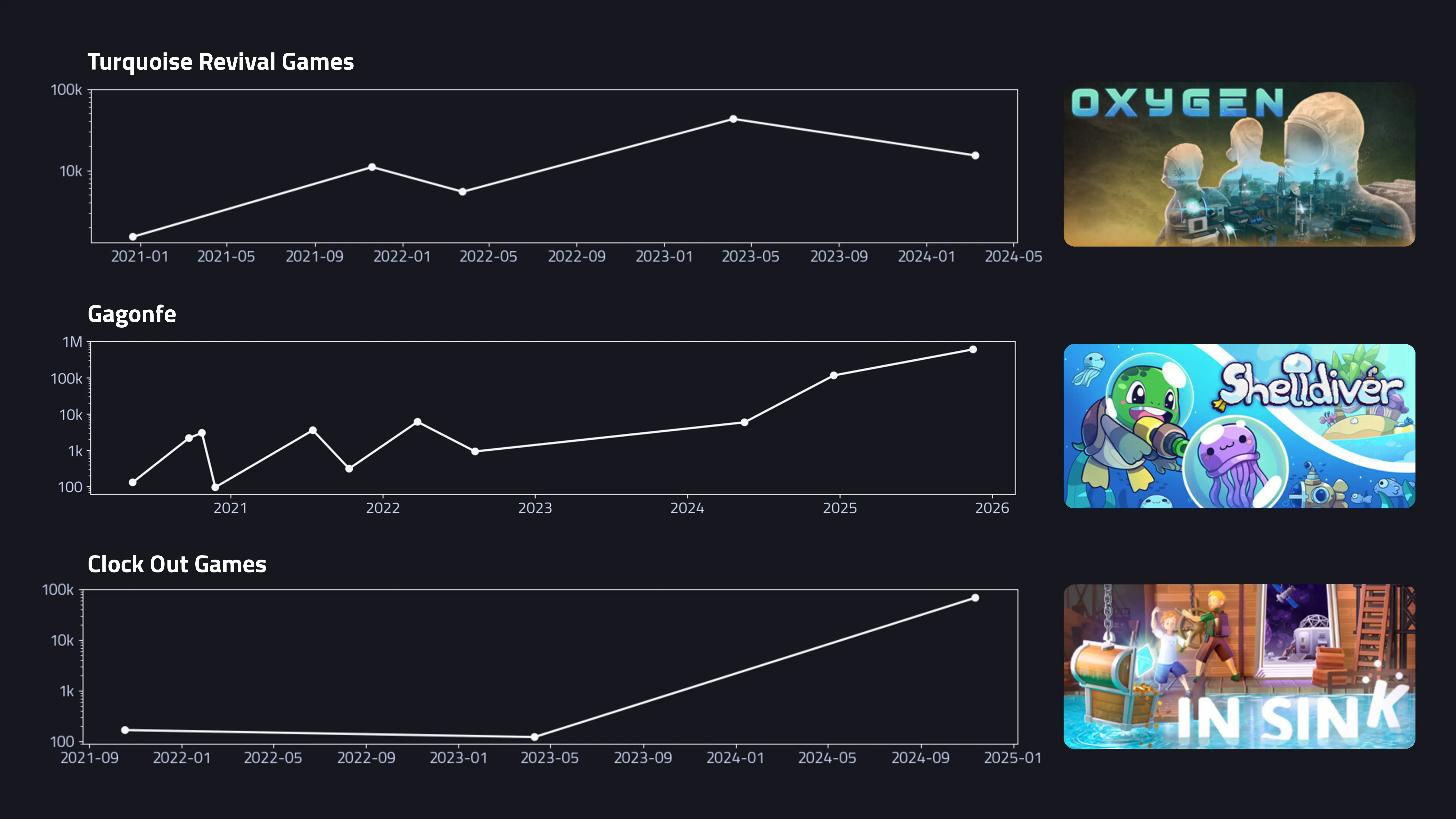
I have pulled a handful of these track records and visualised them as line charts below. The y-axis shows estimated unit sales, with each release marked as a point in time.
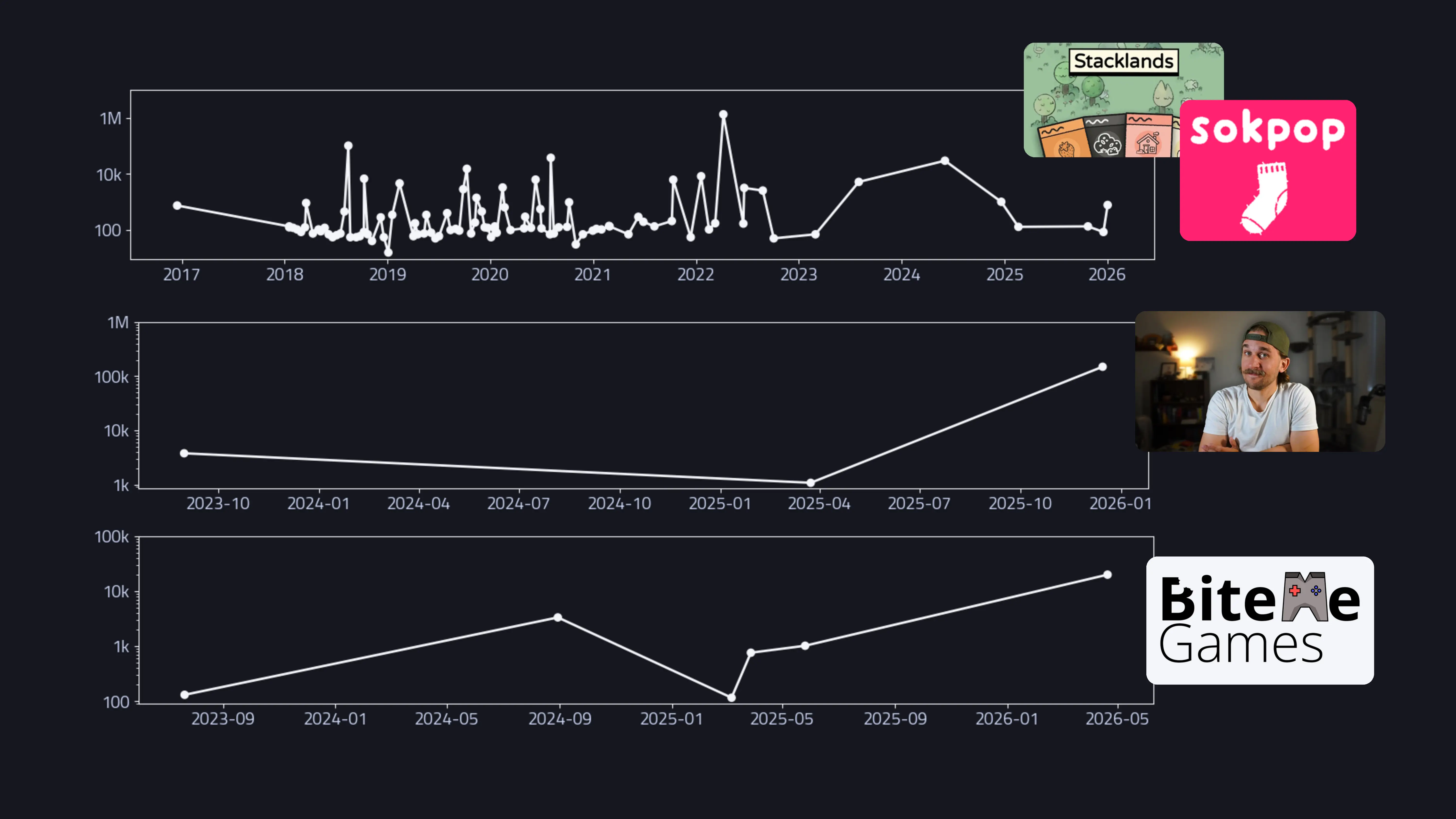
The most striking example is Sokpop Collective. You might wonder how any team has that many releases. Sokpop is a small Dutch studio, sometimes described as a "videogame boy band," where each developer ships their own small games under a shared Patreon and brand. Rather than one person betting everything on a single hit, they pool income and release cadence across many cheap experiments, spreading the financial risk of any one game flopping across the whole collective. The strategy culminated in Stacklands, which crossed 1 million sales. It is the barbell strategy operating at a team level.
A similar small-game approach, combined with content creation and community building, is employed by Andy of Aarimous Games and the small Belgian team at BiteMe Games. Both went a long time without a commercial breakthrough, but kept releasing and building audiences through content and Patreon communities until a hit eventually arrived for each of them.
You do not have to be a content creator to make this work, though. Turquoise Revival Games focused tightly on a specific niche, tycoon management and city builders, and built a recognisable style within it. Crucially, every release has been preceded by a short prologue or proof-of-concept to validate the idea publicly before full commitment.
Then there is Gabriel Goncalves, known as Gagonfe. He built his hit game Toroom entirely as a hobby alongside his day job, treating it as a moonshot while employment provided the safety net. When Toroom found its audience, he did not immediately scale into a large, risky studio. Instead, he lived frugally, reinvested into smaller, highly polished releases like Doomed to Hell and Shelldiver, and turned a hobby into a sustainable full-time career.
Finally, Clock Out Games spent their early releases learning and iterating. They pivoted into the co-op space, committed to validation and community building, and eventually found a breakthrough with In Sink.
Every one of these stories is different in its specifics, but the underlying theme is the same: stamina, strategic persistence, and a long-term mindset.
Looking After Yourself
When speaking to developers in my own network, one theme kept surfacing: the importance of having mechanisms in your life to maintain stamina and weather the difficult periods.
The bigger picture is this: we are lucky to have an ambition to build games. The best way to protect that ambition is to look after yourself, look after the people around you, and remember that this is a marathon, not a sprint.
Which brings me to my final point.
Beware the McNamara Fallacy
The McNamara fallacy is named after Robert McNamara, US Secretary of Defense from 1961 to 1968, and stems from his approach to measuring progress during the Vietnam War. With a background in data-driven management from his time at Ford, McNamara measured success primarily through enemy body counts, ignoring every qualitative factor that could not be easily quantified. The fallacy describes a four-step trap: first you measure what is easy to measure, then you disregard what cannot be measured, then you assume the unmeasurable is unimportant, and finally you conclude that what cannot be measured simply does not exist. As Daniel Yankelovich put it: "This is suicide."
We judge ourselves by sales figures because they are easy to measure. But it is much harder to quantify fun, community, and the joy you bring to a player. If you can genuinely cherish a heartfelt review or a player's reaction during a playtest, I think you will find the real stamina you need to stay in the game.
Across every example I looked at during this research, the success stories shared one thing in common: a deep love for what they do, and a stubborn positivity that outlasted the hard times. That, more than any metric, may be the true driver of long-term success in game development.
Enjoying this article? Sign up to our newsletter for monthly market insights and the latest indie innovations
A Note on the Data
As a data scientist, I have to be honest and footnote this work with a caveat: statistics are often presented with more certainty than they deserve. Data is shaped by what we choose to measure, and equally by what we cannot.
What I have presented here is my best attempt to make sense of a messy and complex market. It will not apply to everyone, but I hope it gives some of you a clearer map for navigating it.
The analysis is based on publicly available data covering every game published on Steam. After cleaning, the dataset covers 62,466 developers, with the following excluded:
- 92 developers suspected of creating spam/low-effort “slop”
- 11,017 developers who have only published titles for free
A few limitations worth keeping in mind: We cannot account for developers that publish under multiple names etc. We also cannot account for experience from publishing on other platforms.
TLDR: Survive!
The indie game market is brutal, uneven, and governed by forces that can feel entirely outside your control. But the data tells a more hopeful story than the headlines suggest. The odds are not fixed. They compound in your favour every time you ship, every time you learn, and every time you choose not to quit. You do not need to be the most talented developer in the room. You do not need a golden publisher deal, a viral moment, or a stroke of luck on day one. You need a strategy that keeps you financially alive, a mindset that keeps you emotionally alive, and the stubborn conviction to stay in the game long enough for the rare, outsized win to find you. Because if the data shows us anything, it is this: the key to success in game development may simply be survival.