Rethinking Steam Saturation: What the Data Says About Game Categories
Share:

Everyone keeps saying Steam is oversaturated. Too many games. Too much noise. Too hard to stand out. But what if we told you that some of the highest-selling categories on the platform are also among the least crowded? That is exactly what we found when we crunched the numbers across every game on Steam using the Game Oracle Steam Map.
Let's dig in.
Mapping Every Game on Steam
At Game Oracle, we have built a mathematical map of every game on Steam. It is not your typical genre list or tag filter. The Steam Map understands visual, thematic, and mechanical similarities between games and places them in a high-dimensional space where similar games sit close together and different games sit far apart. Think of it as a giant galaxy where every star is a game, and constellations form around similar themes/genres.
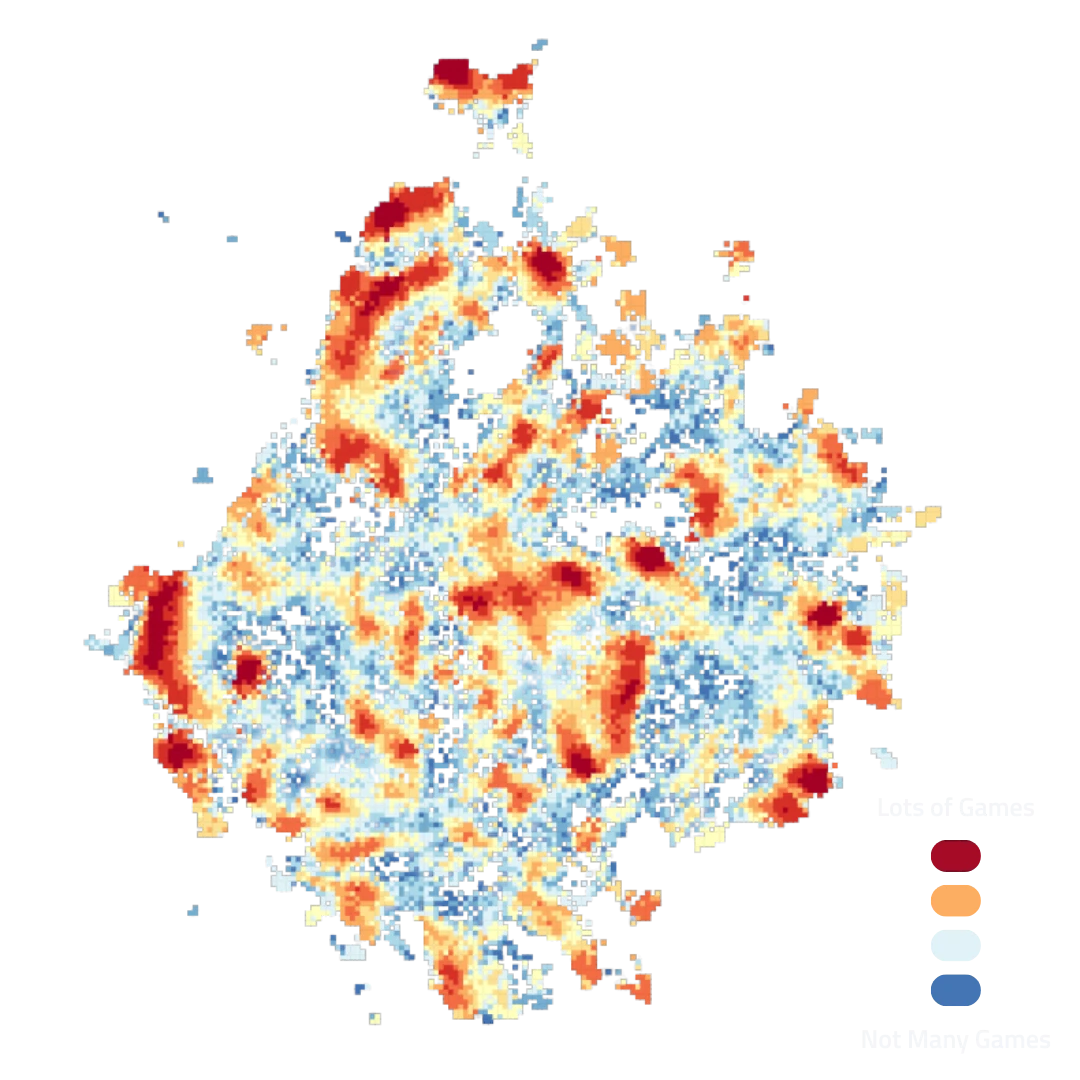
The heatmap above shows the entire Steam catalogue coloured by saturation. Red regions are packed with similar games competing for the same players. Blue regions? Wide open spaces where a well-made game could carve out a new niche or sub-genre.
We assign every game a **Saturation Score** between 0 and 10. It measures how crowded the market is around a given game by looking at the density of nearby titles on our map. A score of 0 means the game is essentially alone, whereas a score of 10 means it's surrounded by lookalikes. You can explore this yourself on the interactive Saturation Map.
Segmenting by Category
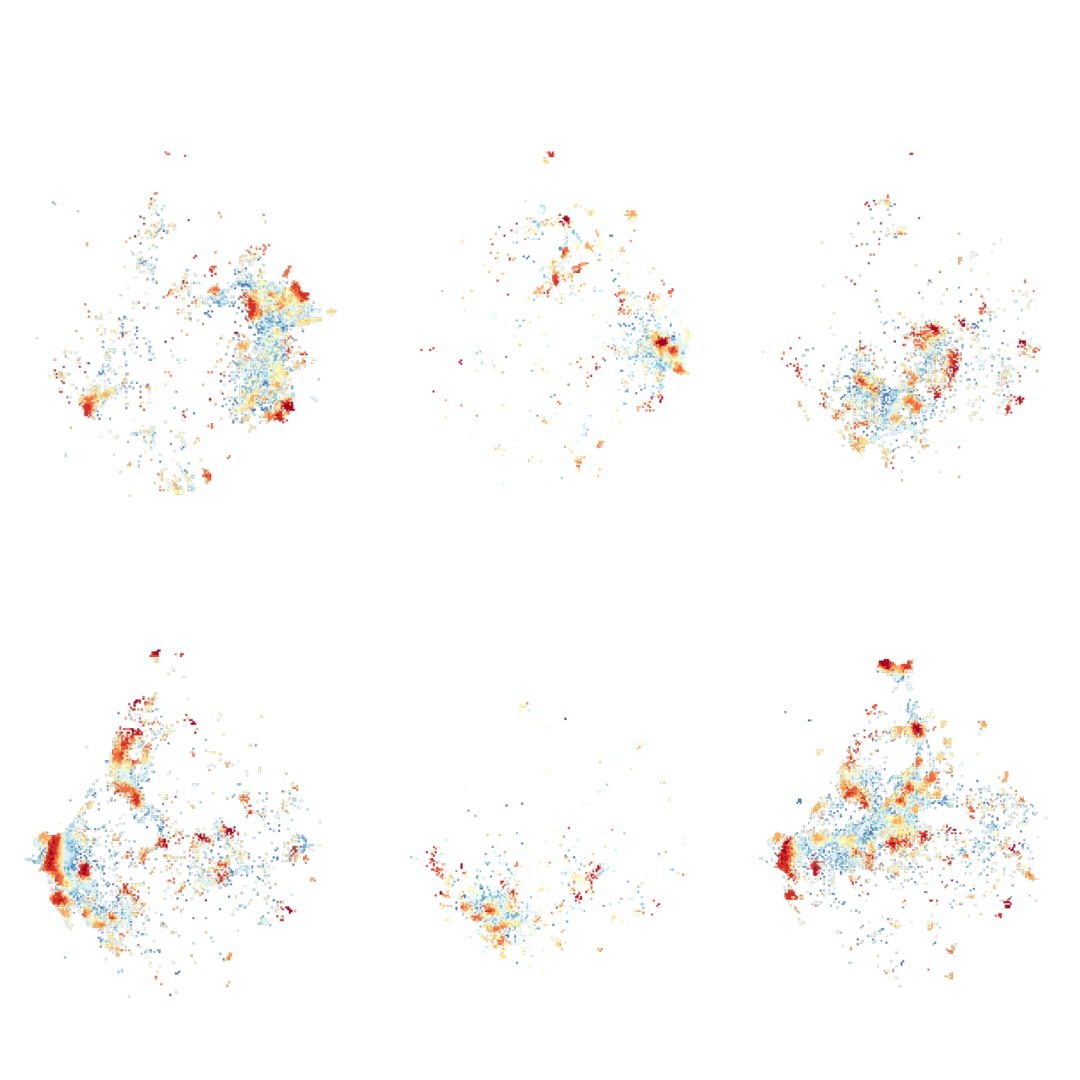
Steam's tagging system lets us slice the map by popular categories, and when we do, some fascinating patterns emerge. Each category lights up a different part of the map.
The six panels below show how different categories occupy different regions of the map. Notice how some, like FPS games, cluster tightly in specific zones, while others, like Puzzle games, scatter more diffusely. That clustering tells us about the diversity amongst these genres.
Sales vs. Saturation: The Sweet Spot
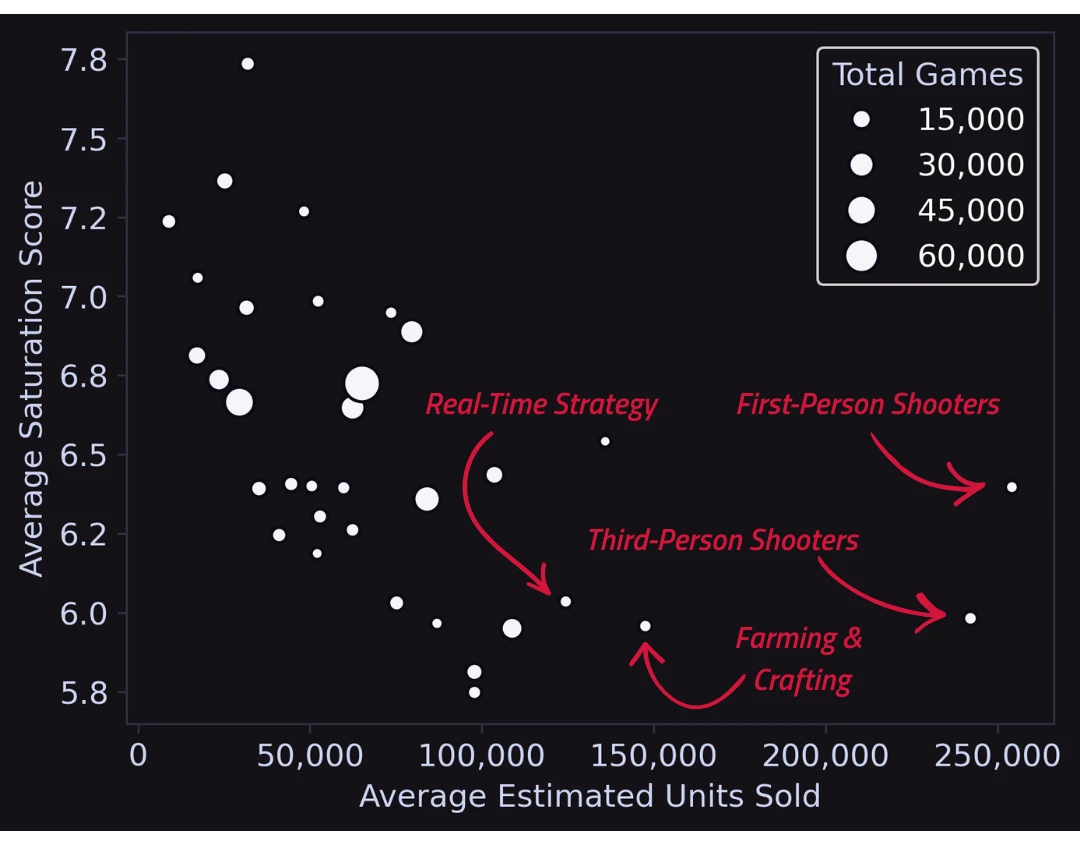
Here is where things get really interesting. We plotted every category on a scatter chart with average estimated units sold on the x-axis and average saturation score on the y-axis. Each dot represents a category, and bigger dots mean more total games in that category.
The bottom-right quadrant of this chart is the sweet spot: categories with high average sales and low average saturation. Four categories stand out with the strongest combination of high sales and low saturation:
- First-Person Shooters (avg. ~254,000 units sold, saturation score 6.40)
- Third-Person Shooters (avg. ~242,000 units sold, saturation score 5.98)
- Farming & Crafting (avg. ~148,000 units sold, saturation score 5.96)
- Real-Time Strategy (avg. ~124,000 units sold, saturation score 6.04)
Sales are estimated using the Boxleiter Method
Wait, Shooters? Really?
If you are surprised to see first-person and third-person shooters on a list of "unsaturated" categories, you are not alone. Shooters are arguably the most iconic genre in gaming. Call of Duty, Halo, Counter-Strike, Fortnite... the big names dominate the conversation.
The AAA shooter space is dominated by a handful of titans with massive budgets and live-service models. We're just speculating, but maybe that means indie developers look at that landscape and think, "No chance." resulting in fewer indie developers actually attempt shooters, which leaves significant pockets of unexplored territory in the broader shooter ecosystem.
Consider the sub-genres here: arena shooters, boomer shooters, extraction shooters, hero shooters, looter shooters. Each one appeals to a distinct audience, and many of those audiences are underserved by indie offerings. The perception of saturation in shooters is driven by AAA visibility, not by actual density of competition across the full spectrum. For an indie with a sharp creative angle, that gap between perception and reality could be pure opportunity.
The Outliers: Indies Winning in Low-Saturation Spaces
To find the success stories hiding in these low-saturation zones, we filtered for self-published, non-AAA games with saturation scores below 2 and over 1,000 units sold. Here is what turned up.
First-Person Shooters
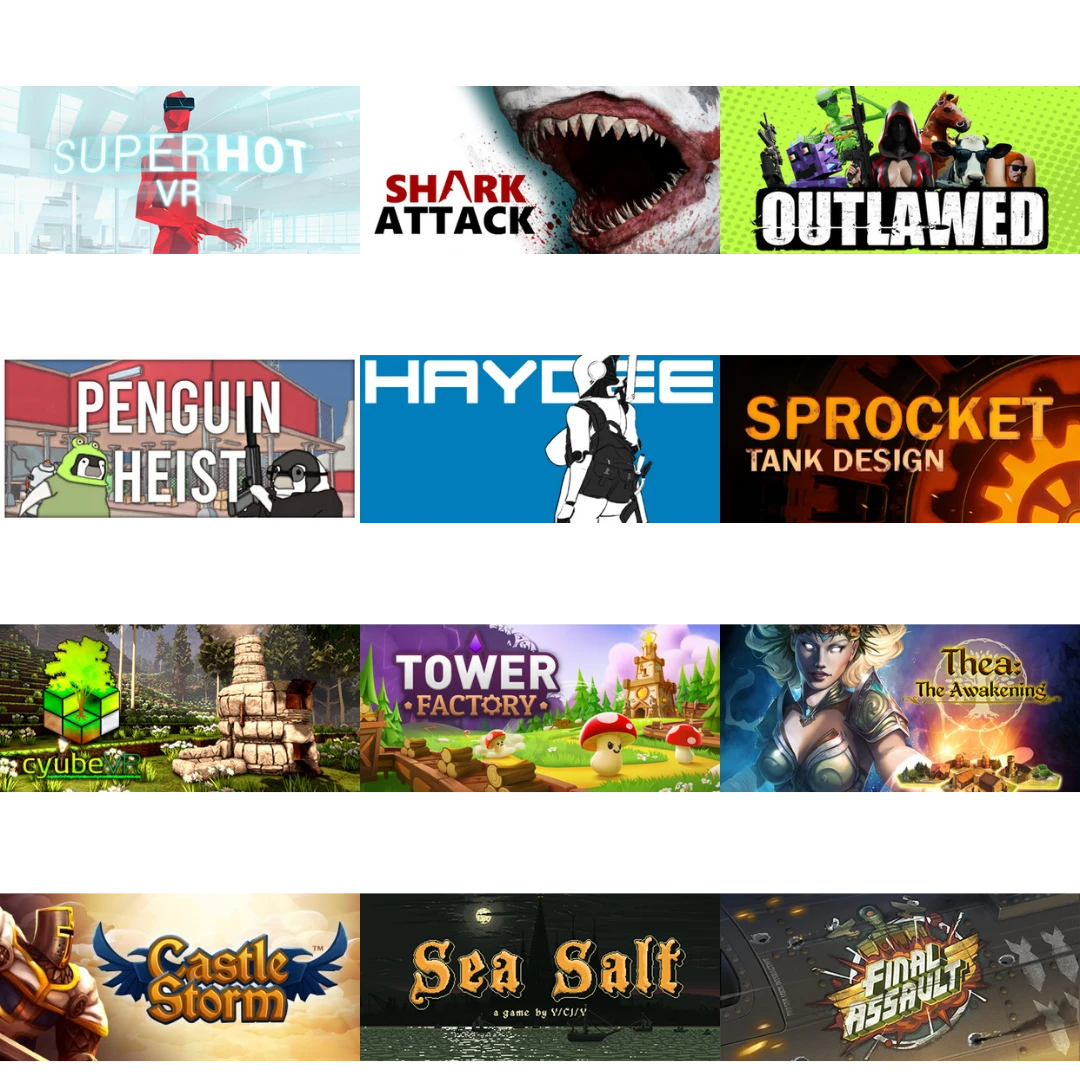
SUPERHOT VR stands in a class of its own with an estimated 508,000 units sold and a saturation score of literally zero. The time-moves-when-you-move mechanic was already brilliant on desktop, but reimagining it from the ground up for VR created something that had no real competition. It won dozens of VR Game of the Year awards and proved that a small team with a radical concept can dominate an entire sub-category1,2.
Shark Attack Deathmatch 2 is the definition of a niche play. Underwater multiplayer combat with sharks? There is quite literally nothing else like it on Steam. It is not absolutely polished to perfection, but it does not need to be when you own an entire concept.
OUTLAWED is a crime-themed PvE/PvPvE extraction shooter that found its footing in an increasingly popular sub-genre. While the game has since been retired from the Steam store, its initial sales demonstrate that there is demand for indie takes on the extraction shooter formula.
Third-Person Shooters
Sprocket is the standout here with an estimated 609,000 units sold and a saturation score of just 1.42. Technically tagged as a third-person shooter, it is really a tank design simulator where you balance mobility, firepower, and armour before testing your creations in combat scenarios. There is genuinely nothing else like it on Steam, and its 11,400+ reviews reflect a deeply engaged community.
Haydee blends old-school metroidvania with third-person shooter and platformer mechanics, wrapped around a distinctive (and famously provocative) character design. Self-published by Haydee Interactive, it carved out a unique space that led to a successful sequel3.
The Greatest Penguin Heist of All Time is a 1-8 player co-op physics-based heist game starring kleptomaniac penguins. Developed by a tiny team under the name "That Fish, That Other Fish," it blends stealth, strategy, and chaotic physics in a way that makes genre classification almost pointless. That is precisely why its saturation score is so low4.
Farming & Crafting
Thea: The Awakening is a turn-based strategic survival game by Polish studio MuHa Games that draws on Slavic mythology. It combines 4X strategy, RPG elements, and card-based combat into something that defies easy categorization. The game earned strong reviews (85% positive) and spawned a franchise5.
cyubeVR is a VR-exclusive voxel crafting game built from the ground up for hand-tracked controllers. By committing fully to VR rather than porting a flat-screen experience, it occupied a space that most crafting games simply do not touch.
Tower Factory mashes tower defense with factory automation and roguelite progression, solo-developed by Gius Caminiti. Released in late 2024, it is a textbook example of genre blending creating low saturation6.
Real-Time Strategy
CastleStorm from Zen Studios smashes 2D physics destruction into tower defense brawling. It drew inspiration from the childhood joy of building and destroying LEGO castles and turned it into a multi-platform hit7,8.
Sea Salt is a Lovecraftian reverse-horror strategy game by Swedish indie duo YCJY, where you play as the eldritch god Dagon commanding a horde of sea creatures against humanity. The "reverse horror" angle (you are the monster, not the hero) is exactly the kind of twist that creates uncontested space9,10.
Final Assault is a WWII-themed RTS built exclusively for VR by Phaser Lock Interactive. It translates classic tabletop-style strategy into an immersive VR experience where you physically grab and place units, and the toy-soldier aesthetic gives it a distinctive charm11,12.
The Pattern: Genre Blending Kills Saturation
Look closely at these outliers and a clear pattern emerges. Almost none of them are straightforward examples of their category. SUPERHOT VR is a puzzle game disguised as a shooter. Sprocket is an engineering sandbox that happens to involve combat. Thea: The Awakening is a card game, RPG, and 4X hybrid. Sea Salt is an action game with Pikmin-like mechanics wrapped in Lovecraftian horror.
The games with the lowest saturation scores tend to live at the intersection of multiple genres or introduce a mechanical twist that makes direct comparison with existing titles nearly impossible. They are not competing on the same axis as everyone else; they are creating new axes entirely.
Beyond Tags: The Limits of Category-Level Analysis
Here is an important caveat. Steam tags and broad categories are useful for high-level pattern recognition, but they are blunt instruments for actual market research. A game tagged "First-Person Shooter" could be anything from a boomer shooter to a narrative walking simulator with a gun. Categories group games that players experience as fundamentally different.
This is exactly why we built tools that go deeper. Our Data Explorer lets you describe a game concept in plain language and find the most similar titles along with their market data. Concept Compass maps your idea against the competitive landscape, helping you find the white space that broad categories cannot reveal.
Steam Is Not Saturated. You Just Need a Map.
The narrative that Steam is oversaturated is one of the most persistent myths in indie game development. Yes, more games are released every year. Yes, visibility is harder to earn. But as this analysis shows, entire categories with strong commercial performance have lower-than-average saturation.
The key takeaway is not "go make a shooter." It is that opportunity exists in places most developers are not looking, or are too intimidated to enter. The games that succeed in low-saturation spaces share a common trait: they combine familiar elements in unfamiliar ways, making them hard to directly compare to anything else on the market.
Steam is not a packed stadium with no seats left. It is more like a sprawling city with crowded districts and quiet neighbourhoods full of potential. The trick is knowing where to look.
Full Category Data
For reference, here is the complete dataset across all 36 categories we analysed, sorted by average estimated units sold.
| Category | Average Estimated Units Sold | Average Saturation Score | Number of Games |
| First-Person Shooter | 254,157 | 6.4 | 2,935 |
| Third-Person Shooter | 242,113 | 6.0 | 4,211 |
| Farming & Crafting | 147,554 | 6.0 | 3,861 |
| Hack & Slash | 135,877 | 6.5 | 1,091 |
| Real-Time Strategy | 124,398 | 6.0 | 3,540 |
| Sandbox & Physics | 108,788 | 6.0 | 21,187 |
| RPG | 103,642 | 6.4 | 13,950 |
| City & Settlement | 97,859 | 5.7 | 5,125 |
| Building & Automation | 97,836 | 5.8 | 10,475 |
| Grand & 4x | 86,952 | 6.0 | 2,168 |
| Strategy | 84,058 | 6.4 | 34,367 |
| Story Rich | 79,623 | 6.9 | 27,803 |
| Space & Flight | 75,216 | 6.0 | 8,143 |
| Tower Defense | 73,599 | 6.9 | 3,912 |
| Adventure | 65,148 | 6.7 | 72,791 |
| Racing | 62,391 | 6.3 | 5,857 |
| Action | 62,384 | 6.6 | 29,134 |
| Fighting & Martial Arts | 59,802 | 6.4 | 5,140 |
| Sports | 52,926 | 6.3 | 6,624 |
| JRPG | 52,390 | 7.0 | 4,605 |
| Utilities & Software | 52,106 | 6.2 | 1,598 |
| Party-Based | 50,514 | 6.4 | 4,334 |
| Metroidvania | 48,284 | 7.3 | 3,184 |
| Turn-Based | 44,531 | 6.4 | 7,033 |
| Simulation | 41,041 | 6.2 | 6,954 |
| Turn-Based Strategy | 35,188 | 6.4 | 9,398 |
| Card & Board | 31,998 | 7.0 | 5,672 |
| Dating | 31,903 | 7.7 | 6,794 |
| Rogue-like & Rogue-lite | 31,569 | 7.0 | 11,077 |
| Casual | 29,494 | 6.7 | 45,875 |
| Visual Novel | 25,237 | 7.4 | 12,805 |
| Platformer & Runner | 23,550 | 6.7 | 23,349 |
| Arcade & Rhythm | 22,403 | 6.7 | 6,818 |
| Shoot 'Em Up | 17,346 | 7.1 | 3,381 |
| Puzzle | 17,145 | 6.8 | 15,401 |
| Hidden Object | 8,967 | 7.2 | 7,872 |
References
- https://www.gamersgate.com/en-gb/product/superhot-vr/
- https://en.wikipedia.org/wiki/Superhot
- https://www.reddit.com/r/Games/comments/54si1l/haydeensfw_3d_metroidvania_now_available_on_steam/
- https://www.instant-gaming.com/en/11425-buy-the-greatest-penguin-heist-of-all-time-pc-mac-game-steam/
- https://en.wikipedia.org/wiki/Thea:_The_Awakening
- https://game8.co/articles/reviews/tower-factory-early-access
- https://www.gamersgate.com/en-hu/product/castlestorm/
- https://en.wikipedia.org/wiki/CastleStorm
- https://www.indiegamewebsite.com/2019/01/17/lovecraftian-strategy-game-sea-salt-revealed/
- https://www.reddit.com/r/patientgamers/comments/l50ke9/sea_salt_2019_is_a_cool_reversehorror_indie_game/
- https://www.roadtovr.com/final-assault-early-access-review-charming-engrossing-rts-rise/
- https://www.youtube.com/watch?v=vHj4SgE9sqc